
Chapter 1: Why Complex-Geometry Parts Are Difficult to Polish Consistently
In precision manufacturing, surface finishing is rarely difficult because a flat outer face cannot be polished. The real challenge appears when one part combines deep holes, blind cavities, intersecting channels, narrow slots, thin walls and free-form surfaces. These features create different local polishing conditions on the same component. A process that produces a good finish on an exposed face may leave burrs, machining marks or trapped contamination in an internal passage.
Traditional mechanical polishing depends on physical access. Abrasive media, wheels, brushes and hand tools must reach the target area with sufficient contact pressure. That requirement becomes a limitation inside deep bores, sharp transitions and small cross-slots. Manual polishing can extend the accessible area, but it also increases labor time and makes results dependent on operator skill. Excessive contact may round edges, deform thin sections or remove material unevenly.
Vibratory finishing and tumbling can improve productivity for suitable batches, but media size and movement still determine whether a feature is reached. They are not a universal answer for small openings, delicate structures or parts that must retain a defined geometry. Conventional electropolishing can provide a smooth metallic surface, yet electrolyte flow, current distribution and process chemistry must be validated for each material and geometry.
For production teams, the central issue is therefore not simply gloss. It is the balance among access, uniform material removal, dimensional stability, throughput, cleaning and repeatability. This is where plasma polishing becomes a useful option for selected complex metal parts.
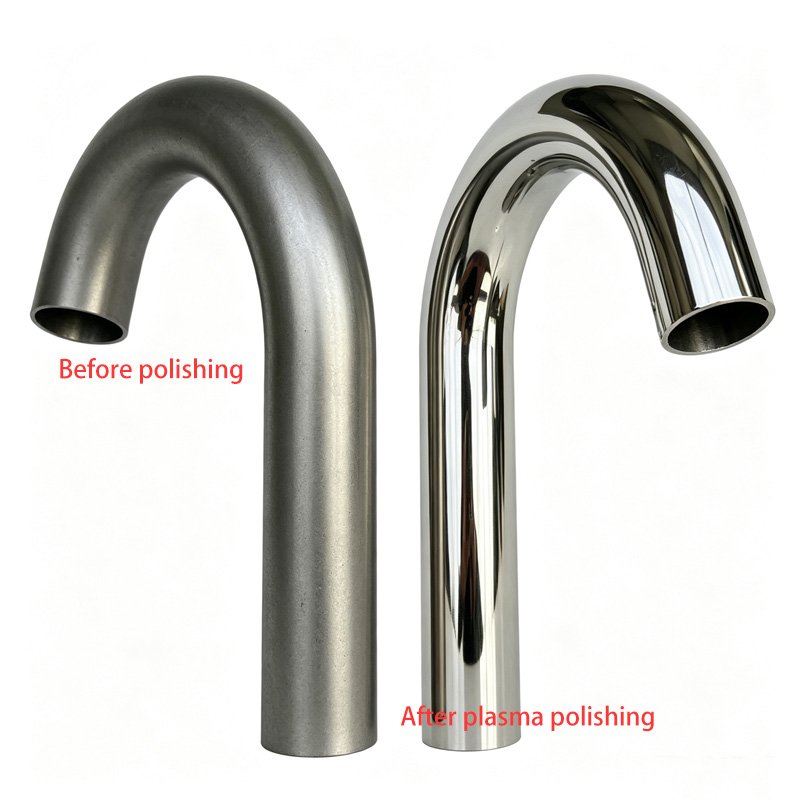
Chapter 2: What Is Plasma Polishing and How Does It Work?
Plasma polishing usually refers to plasma electrolytic polishing, a non-mechanical metal finishing process. In a typical setup, the conductive workpiece is connected as an electrode and immersed in a purpose-designed electrolyte. Under a controlled high-voltage electrical condition, a vapor–plasma envelope can form near the workpiece surface. Charged particles, heat and electrochemical reactions preferentially act on microscopic peaks, gradually smoothing the topography.
The process should not be described as a solid abrasive entering every gap. Its advantage comes from the distributed electrical and chemical environment around the conductive surface. Because no polishing wheel or abrasive head has to follow every contour, the process can be more conformal than contact-based methods when the electrolyte, electrical connection, part orientation and process parameters are properly matched.
Research literature describes the process through several related models, including vapor-film behavior, discharge channels, oxidation and selective removal of surface asperities. The exact mechanism depends on voltage, current density, electrolyte composition, temperature, workpiece material, surface condition and hydrodynamics. For this reason, a responsible equipment supplier should validate a customer’s actual sample rather than promise one universal result.
The term “nano-level” is often used in marketing to describe the scale of surface features being modified. It should not be interpreted as a guarantee that every part will achieve nanometer roughness. Final roughness depends on the initial surface, alloy, geometry, treatment time and measurement method.
Chapter 3: Why Plasma Polishing Fits Complex Structures
The first advantage is reduced dependence on tool access. A Plasmapoliermaschine does not require a wheel or brush to enter every cavity. This can make it suitable for internal passages, curved profiles, small grooves and parts with multiple faces. However, “suitable” does not mean unlimited. Electrical continuity, electrolyte exchange, gas removal and fixture design still affect the result, especially in very deep or narrow cavities.
The second advantage is low mechanical loading. Since the finishing action is not based on abrasive rubbing, the risk of contact-induced scratches, burr folding and mechanical deformation can be lower than with aggressive manual polishing. This is valuable for thin-wall components, precision fittings and parts with fragile edges. It does not remove the need to control temperature, electrical conditions and dimensional change.
The third advantage is process consistency. Once loading, electrical contact, bath condition, orientation and recipe are standardized, a professional polishing machine can reduce the variation associated with hand finishing. Automated lifting, timed recipes, monitoring and traceable records are more important than a large power rating alone.
Plasma polishing is often most effective as a finishing or smoothing step. Deep cracks, large machining steps, heavy burrs, lack-of-fusion defects and severe additive-manufacturing roughness may require deburring, blasting, machining or another pre-treatment first. A complete solution is therefore a process chain: inspect, pre-treat where necessary, plasma polish, rinse, dry and verify.
JINYUAN · PLASMA POLISHING
Hard-to-Reach Surfaces. A Smarter Finishing Solution.
Looking to improve the finishing of complex metal parts? Let’s discuss your workpiece geometry, surface requirements, and production goals.
COMPLEX GEOMETRIES · PRECISION FINISHING · PRODUCTION NEEDS
Chapter 4: How to Design a Reliable Plasma Polishing Process
Begin with material and acceptance criteria. Confirm the alloy, heat treatment, conductivity, welds, coatings and contamination. Define the required roughness parameter, visual appearance, edge condition, dimensional tolerance and cleanliness level. “Mirror finish” is not a sufficient acceptance criterion unless it is linked to a measurement method and a defined sampling plan.
Next, establish the pre-treatment window. Remove oil, scale and loose particles before polishing. If the starting topography is too rough, a short mechanical or abrasive step may reduce the burden on the plasma process. The aim is not to hide defects but to give the finishing process a stable and measurable starting point.
Fixture design is equally important. The fixture must maintain reliable electrical contact without shadowing critical surfaces. It should support safe handling, allow electrolyte movement and avoid trapping gas or liquid in enclosed features. For production, record the loading orientation and contact points as part of the process recipe.
A robust validation plan should vary only a few critical parameters at a time. Measure current or voltage behavior, bath temperature, treatment time and post-process dimensions. Inspect both easy-to-reach and difficult-to-reach areas. Use profilometry, microscopy, visual inspection and dimensional gauges as appropriate. For medical, food, semiconductor or aerospace applications, add the cleanliness, corrosion, bioburden or regulatory tests required by the product specification.
Finally, treat the electrolyte and electrical system as production equipment, not disposable accessories. Ventilation, interlocks, insulation, emergency stop functions, splash control, wastewater handling and operator training must be part of the installation review. The exact operating window should come from the equipment supplier’s validated instructions and the customer’s risk assessment.

Chapter 5: How to Choose a Plasma Polishing Machine and Supplier
A reliable selection process starts with the part, not the product brochure. Ask the polishing machine manufacturer to process representative samples containing the most difficult features. Request before-and-after measurements, photographs of internal areas, material-removal data and the proposed cleaning route. A supplier that only demonstrates a flat coupon has not yet proven suitability for your production geometry.
When comparing metal polishing equipment, evaluate usable tank volume, load capacity, electrical control, fixture flexibility, electrolyte management, filtration, ventilation, safety interlocks, recipe storage and data traceability. A metal surface polishing machine should also support repeatable inspection, not just a visually bright result.
The phrase “best polishing machine” has no universal answer. The best choice depends on alloy, part envelope, cavity dimensions, batch size, target roughness, allowable material removal, operator skill and compliance requirements. For a small precision component, a compact automated cell may be better than a large general-purpose system. For mixed production, recipe management and changeover time may matter more than maximum throughput.
Search terms such as “polishing machine metal” or “professional metal polishing equipment” can help identify suppliers, but they should not replace technical due diligence. Check application experience, sample-testing capability, service response, spare parts, documentation, operator training and references from similar industries. Also ask what the machine cannot do. A transparent limitation is often a better sign than a promise of universal, zero-defect polishing.
The practical buying decision should be based on total process cost: equipment, fixtures, electrolyte, utilities, labor, cleaning, inspection, maintenance, waste handling and rejected parts. A professional supplier should help define a measurable acceptance plan and provide a path from laboratory trials to stable production.
Schlussfolgerung
For complex metal parts, plasma polishing is not a magic replacement for every finishing operation. It is a highly relevant process option when the part requires non-contact smoothing, better access to difficult surfaces and repeatable finishing under a controlled recipe. Its value is greatest when the supplier, workpiece, fixture, electrolyte, inspection method and safety system are evaluated together.
With representative sample trials and measurable acceptance criteria, a plasma polishing machine can become an important part of a modern metal-finishing line for precision hardware, medical components, aerospace parts, automotive fittings and additive-manufactured structures.
YOUR PARTS. YOUR REQUIREMENTS.
Let’s Find the Right Plasma Polishing Machine.
Discuss your material, part dimensions, target surface finish, and production volume with JinYuan.
PLASMA POLISHING EQUIPMENT · INDUSTRIAL FINISHING SOLUTIONS


 Deutsch (Schweiz)
 English
 Français
 Italiano
 Русский
 한국어