
📘 1. Introduction: The Evolution of Metal Polishing Equipment
For decades, the metal finishing industry has relied on separate processes: deburring first, polishing second. Traditional équipement de polissage—including mechanical grinding tools and chemical baths—has always treated surface finishing as a multi-step operation.
However, this approach comes with inherent inefficiencies. A typical polisher machine removes burrs through aggressive abrasion, often leaving micro-scratches behind. Then, additional polishing steps are required to refine the surface. This not only increases production time but also introduces variability.
Saisir le machine de polissage au plasma—a breakthrough in équipement professionnel de polissage des métaux. Unlike conventional équipement de polissage des métaux, plasma systems redefine how surfaces are treated. Instead of mechanically forcing smoothness, they use controlled energy fields to reshape the material at a microscopic level.
Today, industries ranging from équipement de polissage de l'acier inoxydable manufacturing to jewelry polishing equipment production are rapidly adopting plasma technology. Whether it’s équipement de polissage de l'aluminium, équipement de polissage du laitonou équipement de polissage de l'argent, the shift is clear: one process, multiple results.
This transformation is not just about efficiency—it represents a fundamental change in how we understand surface finishing.
📘 2. The Core Secret: Surface Energy Imbalance at the Micro Level
Most explanations about plasma polishing stop at “higher current density at peaks.” While true, this explanation is incomplete.
A more accurate perspective is this: plasma polishing is driven by surface energy imbalance.
At the microscopic level, every metal surface is a landscape of peaks and valleys. These features are not just geometric—they represent differences in electrical potential and energy distribution. In a machine de polissage au plasma, the system naturally directs more energy toward unstable, high-energy regions.
These regions include burrs, sharp edges, and microscopic protrusions. Because they are energetically unfavorable, they attract stronger electrochemical reactions. Meanwhile, recessed areas remain relatively stable and experience slower material removal.
This is why modern équipement de polissage des métaux using plasma technology behaves differently from traditional systems. It doesn’t remove material uniformly—it removes it intelligently.
For a polishing machine factory, this principle is critical. It allows engineers to design systems that don’t just polish—but optimize surfaces dynamically.

📘 3. Why Burrs Disappear First: The Science of Geometric Priority
If traditional équipement de polissage relies on force, plasma technology relies on geometry-driven priority.
In a machine de polissage au plasma, not all parts of a workpiece are treated equally. Instead, the system inherently “prefers” certain features—specifically, burrs, sharp edges, and protrusions. These features act as natural amplifiers of electric fields, creating localized zones where reactions become significantly more intense.
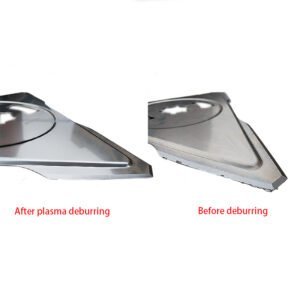
This phenomenon can be understood as geometric priority: the sharper and more exposed a feature is, the more aggressively it interacts with the plasma environment. As a result, burrs are not just removed—they are targeted first, without any need for manual intervention or process sequencing.
Unlike traditional polisher machine methods, where deburring often depends on tool access, pressure, and operator experience, plasma-based équipement de polissage des métaux eliminates these variables. Even in complex geometries or hard-to-reach internal structures, burrs are still preferentially removed because the governing factor is not accessibility—but energy concentration.
This is particularly valuable in industries using équipement de polissage de l'acier inoxydable et équipement de polissage de l'aluminium, where micro-burrs can affect both aesthetics and functionality. Similarly, in high-precision sectors such as jewelry et équipement de polissage de l'argent, preserving fine details while removing imperfections is critical.
From a manufacturing perspective, this behavior transforms how a polishing machine manufacturer designs its systems. Instead of building machines that fight against geometry, modern équipement professionnel de polissage des métaux works with it, leveraging natural physical laws to achieve consistent, automated deburring.
In essence, plasma polishing doesn’t just remove burrs—it understands where they are most likely to exist and eliminates them first.
📘 4. Simultaneous Smoothing: From Roughness to Mirror Finish
While burr removal explains where plasma acts first, it doesn’t fully explain how polishing happens at the same time. The real breakthrough of a machine de polissage au plasma lies in its ability to rebalance the surface during material removal continuously.
At the microscopic level, a metal surface is never flat. It consists of countless peaks and valleys. In traditional équipement de polissage, these irregularities are mechanically forced into uniformity—often leading to over-polishing in some areas and under-polishing in others.
However, plasma-based équipement de polissage des métaux operates differently. As soon as the highest peaks (such as burrs and sharp asperities) are removed due to geometric priority, the system does not stop. Instead, it dynamically shifts its focus to the next set of micro-protrusions.
This creates a layer-by-layer smoothing effect:
- First, large burrs are eliminated
- Then, medium-scale roughness is reduced
- Finally, micro-level irregularities are refined into a smooth, reflective surface
At every stage, the process remains self-regulating. Areas that are still rough continue to receive more energy, while already-smoothed regions naturally experience less interaction. This ensures that the entire surface evolves toward uniformity without over-processing.
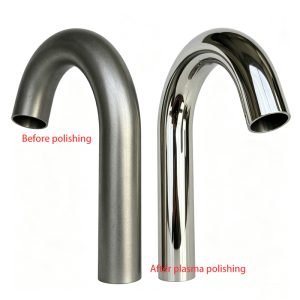
For applications involving équipement de polissage de l'acier inoxydable ou équipement de polissage de l'aluminium, this means achieving both functional smoothness and visual brightness in a single step. In high-end sectors such as jewelry polishing equipment, équipement de polissage du laiton, and équipement de polissage de l'argent, this translates into a consistent mirror-like finish without damaging delicate features.
From a system design perspective, this is why advanced équipement professionnel de polissage des métaux developed by a modern polishing machine factory does not require separate deburring and polishing modules. The process is inherently unified.
Ultimately, plasma polishing transforms what used to be a sequence of operations into a continuous surface evolution process—where roughness is not just removed, but progressively refined into precision.
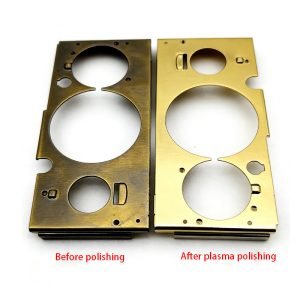
📘 5. Plasma vs Traditional Polishing Equipment
To truly understand the value of a machine de polissage au plasma, it’s essential to compare it with traditional équipement de polissage. The difference is not just in performance—it’s in the philosophy of material removal.
Traditionnel polisher machine systems—such as grinding, buffing, or vibratory finishing—depend on mechanical force. Material is removed through direct contact, which introduces variables like tool wear, pressure inconsistency, and operator skill. As a result, achieving both deburring and polishing requires multiple steps, often across different machines.
Chemical polishing methods attempt to improve efficiency, but they still lack precision. Since reactions occur relatively uniformly, they cannot effectively distinguish between burrs and flat surfaces. This leads to either incomplete deburring or over-etching of critical features.
In contrast, plasma-based équipement de polissage des métaux operates on a completely different principle: selective, energy-driven removal. Instead of applying uniform force or uniform chemistry, a machine de polissage au plasma distributes energy unevenly—favoring high-energy regions like burrs and rough surfaces.
This leads to several key advantages:
- One-step processing: Deburring and polishing occur simultaneously
- Higher consistency: Less dependence on human factors
- Complex geometry capability: Internal channels and intricate shapes are easily processed
- Surface integrity: No mechanical damage or micro-scratches
Pour polissage de l'acier inoxydable, this means achieving a cleaner and more corrosion-resistant surface. For aluminum polishing, it helps prevent deformation while maintaining lightweight structural integrity. In brass and silver polishing, it enables a high-gloss finish while preserving fine details. Meanwhile, jewelry polishing benefits from its high precision and consistent stability.
From the perspective of a polishing machine factory, plasma technology represents a shift from building machines that apply force to systems that control energy. Modern professional metal polishing machine is no longer just a tool—it is an intelligent process platform.
Ultimately, the comparison is clear:
Traditional methods try to force surfaces into smoothness, while plasma polishing allows surfaces to naturally evolve toward perfection.
📘 6. Application Across Materials
One of the most outstanding advantages of a machine de polissage au plasma is its wide adaptability to different materials. Unlike traditional équipement de polissage, which requires changing tools or processes for different materials, plasma-based équipement de polissage des métaux operates on a unified principle: selective material removal driven by energy distribution.
This allows it to be flexibly applied across a wide range of metal materials and industrial scenarios.
In équipement de polissage de l'acier inoxydable, plasma technology effectively removes micro-contaminants and surface irregularities, resulting in a cleaner surface while significantly improving corrosion resistance. This is especially critical in medical, food-grade, and aerospace applications.
For plasma-based équipement de polissage de l'aluminium, traditional methods often cause deformation or surface scratches. In contrast, plasma polishing introduces no mechanical stress, enabling a uniform and bright finish while maintaining structural integrity.
In équipement de polissage du laiton, conventional methods often struggle to achieve both high gloss and detail preservation. Plasma technology addresses this by removing only the outermost irregularities, achieving a balance between brightness and fine detail retention.
Similarly, équipement de polissage de l'argent benefits from this high level of precision. Silver is highly sensitive to over-polishing and chemical reactions, but plasma polishing enhances surface brightness without damaging the material.
For high-value applications such as jewelry polishing equipment, the advantages are even more evident. Complex geometries, fine details, and intricate designs can all be processed uniformly—something that is difficult to achieve with traditional polisher machine systems.
From a buyer’s perspective, this multi-material capability means fewer machines are required. A single advanced plasma polishing machine can handle surface finishing for multiple metal types, significantly improving production flexibility and return on investment.

📘 9. A New Way to Think: Polishing as Controlled Energy Redistribution
The most disruptive idea behind the machine de polissage au plasma is not the machine itself—but the way it changes how we define polishing.
Traditionnel équipement de polissage is built on a simple assumption: surfaces become smooth through external force. Whether it is grinding, buffing, or abrasive polishing, the logic has always been “mechanically remove the uneven parts.” Even advanced polisher machine systems still follow this principle.
Plasma technology breaks this logic completely.
Instead of forcing the surface into smoothness, équipement de polissage des métaux based on plasma works through controlled energy redistribution. The surface is not “cut” or “scraped.” Instead, energy naturally concentrates on unstable micro-regions, and material is removed only where it is energetically unfavorable.
This shift changes everything:
- Polishing is no longer a mechanical act—it becomes a physical optimization process
- The surface is no longer passive—it becomes a self-adjusting system
- The machine is no longer just a tool—it becomes an energy controller
This is why advanced équipement professionnel de polissage des métaux developed by modern polishing machine factory systems can achieve deburring and polishing simultaneously. The process is not sequential—it is emergent.
📘 10. Conclusion: Why Plasma Polishing Becomes the New Standard
Plasma polishing can remove burrs and polish surfaces at the same time because it does not treat the surface uniformly like traditional mechanical methods.
Instead, it works through a natural energy imbalance on the material surface. Sharp edges, burrs, and protrusions have higher energy and stronger local reactions, so they are removed first. At the same time, the remaining surface is continuously leveled because the process keeps acting on microscopic high points while leaving lower areas relatively untouched.
As this selective removal continues, the surface is gradually smoothed and refined in one continuous process—burrs are eliminated first, and overall roughness is reduced at the same time.
In essence, plasma polishing achieves both functions simultaneously because it is driven by selective, energy-based material removal rather than uniform mechanical abrasion.
Need a Plasma Polishing Solution?
Contact our engineering team to get professional recommendations for your metal polishing application.


 Français
 English
 Deutsch (Schweiz)
 Italiano
 Русский
 한국어