
The Real Problem with Traditional Surface Polishing Machines
For decades, mechanical polishing machines have been treated as a default solution rather than a strategic choice. Grinding wheels, abrasive belts, buffing heads, and manual polishing stations dominate factory floors worldwide. Yet the real bottleneck of these traditional surface polishing machines is not processing speed — it is process instability.
Mechanical polishing is inherently dependent on physical contact. This means every variable matters: operator skill, applied pressure, tool wear, angle consistency, abrasive condition, and part positioning. Even in automated systems, contact-based polishing introduces vibration, uneven force distribution, and unpredictable material removal rates. Over time, these variables accumulate, causing inconsistent surface quality between batches and even between parts in the same batch.
The problem becomes more severe as part geometry grows more complex. Inner holes, blind cavities, lattice structures, thin walls, and sharp edges are not “polishing-friendly” features — they are structural liabilities under mechanical polishing logic. Tools cannot reach certain areas. Contact pressure concentrates on edges, leading to rounding, deformation, or material loss beyond tolerance. Thin-walled parts may bend, chatter, or fracture entirely.
In high-precision industries such as aerospace, medical devices, optics, and precision hardware, surface finishing is no longer about appearance alone. Surface roughness, micro-cracks, residual stress, and dimensional deviation directly affect fatigue life, corrosion resistance, and functional reliability. Mechanical équipement de polissage was never designed to control surface integrity at the microscopic level — only to remove material visibly.
As manufacturing shifts toward higher precision, tighter tolerances, and complex geometries, the limitations of traditional surface polishing machines are no longer marginal inefficiencies. They are systemic risks that directly limit product quality, scalability, and profitability.

What Is Plasma Polishing? Understanding the Science Without the Complexity
Plasma polishing is often misunderstood as an advanced form of electro-polishing or a niche laboratory process. In reality, it represents a fundamentally different surface finishing mechanism designed for industrial-scale precision manufacturing.
A machine de polissage au plasma operates on a gas–liquid plasma discharge principle. When a metal workpiece is immersed in a specially formulated electrolyte and a controlled voltage is applied, a thin vapor layer forms on the surface of the part. Within this vapor envelope, localized plasma micro-discharges occur uniformly across the surface.
These micro-discharges remove material not by mechanical abrasion, but by controlled energy transfer. High-energy plasma selectively smooths surface asperities at the microscopic level while leaving the bulk geometry intact. Because there is no physical contact, issues such as tool wear, pressure inconsistency, and mechanical deformation are eliminated entirely.
One of the most critical advantages of plasma polishing is self-regulating material removal. Peaks on the surface experience stronger plasma activity than valleys, resulting in automatic leveling. This is why plasma polishing excels at reducing surface roughness efficiently without over-processing edges or corners.
From an engineering perspective, plasma polishing is not about replacing polishing tools — it replaces the entire concept of tool-based finishing. Parameters such as voltage, electrolyte composition, temperature, and process time define the result with high repeatability. Once optimized, the process delivers consistent outcomes regardless of operator or part orientation.
This makes plasma polishing not only a finishing method, but a controllable surface engineering process, suitable for demanding industrial environments.
Plasma Polishing Machine vs. Mechanical Polishing: Not an Upgrade, but a Different Logic
At first glance, plasma polishing machines are often compared to mechanical polishing equipment as if they were part of the same evolutionary path. This comparison is misleading. Plasma polishing is not an improved polishing wheel or a more precise abrasive system — it is a fundamentally different material removal philosophy.
Mechanical polishing relies on force-driven interaction. Abrasives physically cut, grind, or shear material from the surface. The process is linear: more pressure or longer contact means more material removed. This logic inevitably leads to trade-offs between surface quality, dimensional accuracy, and process safety.
A plasma polishing machine, by contrast, operates through energy-driven interaction. Material is removed by controlled plasma discharge at the microscopic level. There is no direct contact, no mechanical stress concentration, and no cumulative tool degradation. Removal occurs only where energy density exceeds the surface binding threshold — not where pressure happens to be applied.
This distinction explains why mechanical polishing struggles with sharp edges, internal geometries, and thin-walled structures. Force has direction, and force concentrates. Plasma energy, however, distributes uniformly around the part surface. Corners are not “hit harder,” and recesses are not “missed.”
From a production engineering standpoint, this means plasma polishing eliminates an entire category of failure modes: over-polishing, under-polishing, deformation, and tool-induced defects. It transforms surface finishing from a skill-dependent craft into a parameter-controlled process.
In short, plasma polishing does not compete with mechanical polishing — it replaces the logic behind it.
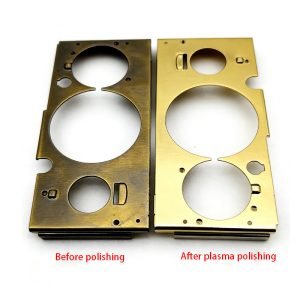
Why Plasma Polishing Excels at Complex, Thin, and Precision Parts
Complex geometry has become the norm rather than the exception in modern manufacturing. Lightweight structures, miniaturized components, internal channels, and functional surfaces are now standard design requirements. Unfortunately, these same features expose the fundamental weakness of mechanical polishing.
Plasma polishing excels in these applications because the plasma field envelopes the entire workpiece simultaneously. Every exposed surface — external, internal, convex, concave — experiences the same controlled energy environment. There is no need for tool access, alignment, or repositioning.
Thin-walled parts benefit even more significantly. Mechanical polishing introduces bending moments and vibration, often exceeding the elastic limits of thin sections. Plasma polishing applies zero mechanical load. As a result, parts retain flatness, concentricity, and structural integrity throughout the process.
Precision components also demand strict dimensional control. Plasma polishing removes material in the micron or sub-micron range, making it ideal for applications where tolerances cannot be compromised. The process improves surface quality without altering functional geometry.
This is why plasma polishing is increasingly specified — not optional — in aerospace alloys, medical implants, precision electronics housings, micro-mechanical parts, and high-end industrial hardware.
From Deburring to Mirror Finish: One Machine, Multiple Surface Results
One of the most misunderstood aspects of plasma polishing is its versatility. Many assume it is suitable only for fine polishing or cosmetic finishing. In reality, a single plasma polishing machine can perform multiple surface functions across different stages of manufacturing.
By adjusting process parameters, plasma polishing can effectively remove burrs generated by machining, MIM, casting, or additive manufacturing. Unlike mechanical deburring, it does not leave secondary scratches or edge damage.
Edge rounding is another key capability. Plasma polishing naturally softens sharp edges without destroying dimensional intent, producing controlled radius transitions that improve safety, assembly performance, and fatigue resistance.
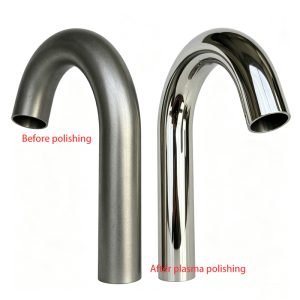
With further optimization, the same system can achieve surface smoothing and even mirror-level finishes. This eliminates the need for multiple standalone machines and intermediate handling steps.
For manufacturers, this consolidation reduces floor space, labor dependency, and process complexity — while improving consistency across surface requirements.
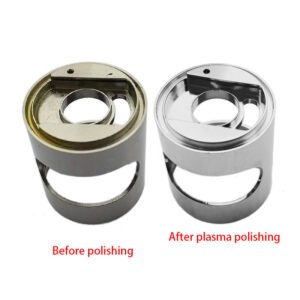
Surface Integrity Matters More Than Shine
Surface brightness is easy to see. Surface integrity is what determines performance.
Plasma polishing improves surface roughness to Ra ≤ 0.05 μm while eliminating micro-cracks, embedded abrasives, and residual stress layers commonly introduced by mechanical polishing.
This directly enhances fatigue resistance, corrosion behavior, and long-term reliability. In functional components, these improvements are far more critical than visual appearance.
Plasma polishing delivers surfaces that are engineered, not merely polished.
Productivity, Cost, and Stability: The Manufacturing ROI of Plasma Polishing
Plasma polishing dramatically reduces processing time, labor dependency, and rework rates. Minutes replace hours. Automation replaces craftsmanship dependency.
With no consumable tools and high process repeatability, total cost of ownership decreases significantly while yield increases.
This is not incremental improvement — it is systemic ROI optimization.
What Defines a Qualified Plasma Polishing Machine?
A qualified plasma polishing machine is defined by stability, reliability, and consistency — not peak power or size. Long-term uptime, reproducible results, and process safety matter more than specifications on paper.
Choosing the Right Polishing Machine Supplier: Beyond the Machine Itself
An experienced supplier provides process development, validation, customization, and long-term support. Equipment without know-how is just metal and wiring.
FAQ
Q1: Does plasma polishing damage dimensions?
No. Material removal is controlled and uniform.
Q2: Can it polish inner holes?
Yes. Plasma excels where tools cannot reach.
Q3: Is it environmentally friendly?
Cleaner, safer, and easier to manage than traditional methods.


 Français
 English
 Deutsch (Schweiz)
 Italiano
 Русский
 한국어