
Introduction: Why 304 Stainless Steel Is the “Golden Material” for Plasma Polishing
For decades, manufacturers have searched for the perfect balance between appearance, corrosion resistance, and production efficiency when finishing stainless steel surfaces. Among all stainless steel grades, 304 polished stainless steel has quietly become one of the most compatible materials for advanced plasma polishing technology.
What makes 304 stainless steel special is not only its corrosion resistance or affordability. The real advantage appears during the polishing process itself. Unlike some high-hardness stainless steels that are difficult to stabilize during finishing, polishing 304 stainless steel is remarkably consistent. This allows manufacturers to achieve uniform brightness, smooth edges, and even mirror polished stainless steel surfaces with a far lower defect rate.
Traditional polishing stainless steel methods often rely on mechanical grinding wheels, abrasive belts, or buffing compounds. These processes may produce acceptable results on flat surfaces, but they struggle with deep holes, hidden corners, thin walls, and precision geometries. More importantly, conventional stainless steel polishing methods introduce mechanical stress, heat, and microscopic scratches that may reduce long-term corrosion resistance.
This is where plasma polishing changes the game.
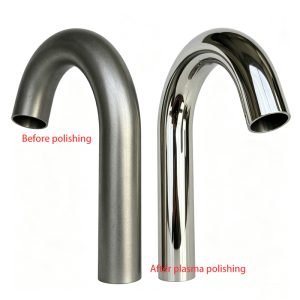
Instead of physically grinding the surface, a plasma polishing machine removes microscopic irregularities through controlled electrochemical reactions. The process selectively smooths peaks on the metal surface while preserving the core geometry of the part. As a result, manufacturers can produce polished stainless steel mirror finishes with exceptional consistency across large production batches.
Another overlooked advantage is cleanliness. Traditional stainless steel polishers often leave behind polishing paste residue or embedded abrasive particles. Plasma polish processes eliminate this problem entirely, making the technology especially valuable for food-grade hardware, medical devices, kitchenware, and precision industrial components.
Today, many stainless steel polishing company manufacturers are moving toward automated plasma polishing equipment because it offers not only aesthetic improvement, but also functional enhancement. Surface passivation becomes denser, salt spray resistance improves, and the final stainless steel polished mirror surface remains stable for longer periods.
In modern manufacturing, the question is no longer whether plasma polishing works on 304 stainless steel. The real question is how far this technology can push the limits of stainless steel polishing quality, efficiency, and surface perfection.
Chapter 1: What Happens to 304 Stainless Steel During Plasma Polishing?
When people first see a plasma polished component, the immediate reaction is usually focused on the brightness. However, the real transformation of 304 polished stainless steel happens at the microscopic level — far beyond what the human eye can directly observe.
Traditional polishing stainless steel methods rely on physical abrasion. Grinding wheels, abrasive belts, and buffing compounds mechanically force the surface into becoming smoother. The problem is that this process often creates new scratches while removing old ones. Even mirror-looking surfaces may still contain microscopic tearing, embedded abrasive particles, and stress marks.
Plasma polishing technology works in a completely different way.
Inside a plasma polishing machine, the 304 stainless steel part becomes part of a controlled electrochemical reaction. Under high-energy conditions, microscopic peaks on the metal surface dissolve faster than low areas. Instead of “grinding” the surface flat, plasma polish selectively removes irregularities at the micro level.
This creates a self-leveling effect.
The result is a dramatically smoother stainless steel polished mirror surface without aggressive mechanical force. Unlike conventional stainless steel polishing equipment, the process can access hidden geometries that polishing wheels physically cannot reach — including blind holes, internal channels, thread roots, tiny gaps, and cross-drilled structures.
One of the biggest advantages of polishing 304 stainless steel with plasma technology is consistency. Because 304 stainless steel has stable chemical activity, the electrochemical reaction remains highly controllable. This is why manufacturers can process entire baskets of components while maintaining nearly identical brightness and texture across every part.
Another major improvement happens beneath the shine itself.
During machining, cutting, grinding, and welding, stainless steel surfaces develop damaged layers known as “deformation layers.” These layers may contain microcracks, heat damage, iron contamination, and chromium depletion. Even after conventional stainless steel metal polish processes, some of these defects remain trapped below the surface.
Plasma polishing removes these unstable layers more effectively.
After the damaged layer disappears, the surface can naturally form a denser chromium-rich passive film. This directly improves corrosion resistance, especially for products exposed to moisture, chemicals, salt spray, or outdoor environments.
This is why mirror polish stainless steel created through plasma technology often performs better than visually similar mechanically polished parts.
Another fascinating detail is edge behavior. Mechanical polishing usually sharpens or distorts thin edges unevenly. In contrast, plasma polishing naturally softens micro burrs and creates subtle rounded transitions. The final polished mirror stainless steel surface feels smoother to the touch and safer in handling applications.
For manufacturers producing medical instruments, kitchenware, bathroom hardware, decorative products, or precision MIM components, this microscopic surface refinement creates both aesthetic and functional value.
Ultimately, plasma polishing of stainless steel is not simply about making metal shiny. It is about rebuilding the surface structure of 304 stainless steel at the microscopic level — creating cleaner, smoother, more corrosion-resistant, and more uniform metal surfaces than traditional polishing methods can typically achieve.

Chapter 2: Mirror Finish vs Satin Finish — How Flexible Is Plasma Polishing?
One of the biggest misconceptions about plasma polishing is that it only creates ultra-bright mirror surfaces. In reality, plasma polishing technology is far more flexible than traditional stainless steel polishing processes. It is not simply a “mirror-making” process — it is a controllable surface engineering method capable of producing multiple visual and functional textures on 304 stainless steel.
This flexibility is exactly why plasma polishing is rapidly becoming the preferred finishing solution for high-end manufacturers.
In conventional polishing stainless steel operations, achieving different surface appearances usually requires multiple production steps. A factory may need separate grinding belts, buffing wheels, abrasive compounds, and even different stainless steel polishing machines for matte, satin, brushed, or mirror effects.
With plasma polishing, many of these adjustments can be controlled through process parameters instead of changing physical tooling.
For example, when manufacturers want a soft satin texture on polished stainless steel sheet metal, the plasma reaction can be tuned to preserve subtle directional patterns while removing burrs and micro-defects. The result is a refined matte appearance that still feels smooth and premium.
On the other hand, if the goal is mirror polished stainless steel, the process parameters can increase surface leveling intensity and reduce microscopic roughness further. This creates the highly reflective stainless steel polished mirror effect commonly seen in luxury hardware, medical instruments, premium kitchenware, and decorative architectural components.
What makes this especially impressive is the consistency.
Traditional stainless steel polishers often create uneven reflections due to pressure variations from manual polishing. Some areas become over-polished while others remain dull. On complex parts, achieving a perfectly uniform polished stainless steel mirror finish becomes extremely difficult.
Plasma polishing removes this inconsistency.
Because the electrochemical reaction acts uniformly across exposed metal surfaces, the final appearance becomes much more stable throughout the entire component. Even complex geometries can maintain balanced brightness and texture.
This capability is particularly valuable in industries where appearance directly affects perceived product value.
For example:
- Luxury bathroom hardware often prefers semi-mirror finishes that reduce fingerprint visibility.
- Premium watch components may require ultra-bright mirror polish stainless steel surfaces.
- Food-grade equipment often uses satin finishes to combine hygiene with reduced glare.
- Decorative panels made from polished stainless steel sheet metal may require highly controlled reflection characteristics.
Another hidden advantage is texture smoothness.
Even when manufacturers intentionally choose matte or satin finishes instead of mirror polished stainless steel, plasma polishing still removes microscopic sharpness from the surface. This means the final texture feels softer and cleaner than mechanically brushed stainless steel.
The surface is not only visually refined — it is physically refined at the microscopic level.
Modern stainless steel polishing company manufacturers increasingly realize that customers no longer judge products only by brightness. Today’s market values texture consistency, touch quality, corrosion resistance, and visual sophistication equally.
That is why plasma polishing technology is no longer limited to industrial deburring. It is becoming a precision surface design tool capable of customizing the final personality of 304 stainless steel products.
In many cases, the real advantage of plasma polishing is not simply achieving the brightest finish. It is achieving the exact finish manufacturers actually want — repeatedly, consistently, and efficiently.
Chapter 3: Why Traditional Mechanical Polishing Struggles With Complex 304 Parts
At first glance, traditional stainless steel polishing seems simple: use abrasive force to make metal surfaces smoother and brighter. For decades, this method dominated the industry because it worked reasonably well on flat and accessible surfaces.
But modern manufacturing has changed dramatically.
Today’s 304 stainless steel components are no longer simple flat plates or basic round tubes. Manufacturers now produce highly complex geometries with blind holes, internal channels, threaded cavities, laser-cut edges, micro gaps, and ultra-thin structures. These designs improve product functionality, but they also expose the limitations of conventional polishing methods.
This is where plasma polishing technology begins to show a completely different level of capability.
Traditional polishing machines for stainless steel depend on physical contact. Grinding wheels, buffing pads, and abrasive belts can only polish the areas they can physically reach. As product geometry becomes more complicated, the polishing process becomes increasingly inconsistent.
For example, consider a precision 304 stainless steel component with multiple intersecting holes.
A conventional stainless steel polishing machine may successfully polish the outer surface while leaving burrs, oxidation, and machining marks deep inside the cross holes. Even skilled workers often struggle to maintain uniform results because polishing pressure changes continuously across different areas.
The result is a familiar problem in the industry:
the outside looks polished, but the inside remains unfinished.
Plasma polishing works differently because it is not limited by direct mechanical contact.
During plasma polishing, the electrochemical reaction naturally reaches every exposed conductive surface. Internal cavities, narrow gaps, deep holes, thread roots, and hidden corners can all be processed simultaneously. Instead of polishing only what tools can physically touch, plasma polish treats the entire surface structure more uniformly.
This creates a major advantage for industries manufacturing precision stainless steel products.
For example:
- Medical instruments often contain extremely small internal features that mechanical stainless steel polishers cannot reach effectively.
- Food-grade fittings require fully cleaned internal surfaces to avoid bacterial accumulation.
- Bathroom hardware contains curved transitions and hidden corners that must remain visually consistent.
- MIM 304 components frequently contain micro-scale structures impossible to polish manually.
- Precision fasteners require burr-free thread roots without dimensional distortion.
In all of these applications, polishing 304 stainless steel using traditional methods becomes labor-intensive, inconsistent, and difficult to automate.
Another major challenge with mechanical polishing is edge control.
When operators aggressively polish sharp corners or thin-wall areas, material removal often becomes uneven. This may cause deformation, edge collapse, overheating, or dimensional instability. Thin decorative stainless steel parts are especially vulnerable to these problems.
Plasma polishing technology reduces these risks significantly.
Because the process removes microscopic surface peaks instead of aggressively grinding the metal, the polishing force applied to the part is extremely low. Thin walls remain stable, precision edges stay controlled, and complex geometries maintain their original structural integrity.
This is one reason why many manufacturers now use plasma polishing equipment not only for appearance improvement, but also for precision quality control.
There is also an economic factor that is changing the industry.
Traditional stainless steel polishing often depends heavily on manual labor. Skilled polishing workers require years of experience, and maintaining consistent quality across large production batches remains difficult. As labor costs continue rising globally, many manufacturers are searching for more automated and repeatable solutions.
Plasma polishing offers exactly that.
Instead of relying on operator skill alone, manufacturers can standardize process parameters and achieve repeatable polished stainless steel mirror results across large-scale production.
In many factories, the real reason plasma polishing is replacing traditional polishing methods is not simply because it creates brighter surfaces. It is because modern product designs have become too complex for conventional polishing systems to handle efficiently.
As 304 stainless steel components continue evolving toward smaller, thinner, and more intricate structures, plasma polishing is no longer just an alternative technology — it is becoming a necessary manufacturing solution.

Chapter 4: Can Plasma Polishing Improve Corrosion Resistance of 304 Stainless Steel?
Many people assume that stainless steel already “does not rust,” so polishing is only about appearance. In reality, surface finishing has a direct impact on how well 304 stainless steel resists corrosion over time.
In some cases, a poorly polished stainless steel component may corrode faster than an untreated one.
This is why advanced manufacturers no longer view plasma polishing technology as purely decorative. Instead, they increasingly treat it as a functional surface enhancement process.
To understand why, we first need to examine what actually happens to 304 stainless steel during machining.
Cutting, drilling, grinding, welding, and mechanical stainless steel polishing all damage the outer metal layer to some degree. These processes create microscopic scratches, torn metal structures, embedded contaminants, heat-affected zones, and chromium-depleted regions.
Although these defects may be invisible to the naked eye, they become weak points for corrosion.
Moisture, salts, cleaning chemicals, and industrial pollutants tend to attack these unstable microscopic areas first. Over time, the surface may develop rust spots, discoloration, pitting, or uneven oxidation.
This is especially problematic for products used in kitchens, bathrooms, outdoor equipment, medical devices, and marine environments.
Traditional polishing stainless steel methods can improve visual smoothness, but they do not always fully remove the damaged surface layer. In some cases, aggressive buffing may even smear contaminants deeper into the metal surface.
Plasma polishing works differently.
Instead of mechanically rubbing the metal, plasma polishing machine systems remove the unstable microscopic layer through controlled electrochemical dissolution. This process smooths the surface while simultaneously eliminating many of the microscopic defects created during machining.
The result is not only a brighter surface, but also a cleaner and more chemically stable one.
One of the biggest improvements occurs in the passive layer formation.
304 stainless steel naturally protects itself through a chromium-rich oxide film called the passive layer. However, machining damage can weaken this protective barrier. Plasma polishing helps expose fresh, uniform metal surfaces that allow a denser and more continuous passive film to form afterward.
This significantly improves corrosion resistance.
In salt spray testing, plasma polished stainless steel often performs noticeably better than mechanically polished components with similar visual brightness. The difference becomes even more obvious during long-term exposure to humid or corrosive environments.
This is one reason why polished mirror stainless steel produced through plasma technology is increasingly used in high-end and high-reliability industries.
For example:
- Medical devices require ultra-clean corrosion-resistant surfaces.
- Food processing equipment must resist chemical cleaning agents.
- Bathroom hardware faces constant humidity exposure.
- Marine components encounter salt-rich environments.
- Decorative architectural panels need long-term visual stability.
In all these applications, stainless steel polished mirror surfaces are expected not only to look beautiful on day one, but also to maintain their appearance for years.
Another important factor is contamination reduction.
Traditional stainless steel polishers often use abrasive compounds that may leave microscopic residues trapped inside the surface. These residues can later become corrosion initiation points.
Plasma polish processes eliminate this risk because no abrasive media directly contacts the metal surface.
The final polished stainless steel mirror surface is cleaner, more uniform, and easier to maintain.
Interestingly, many manufacturers discover that corrosion resistance improvements are not always immediately visible. The true value appears months or years later, when plasma polished 304 stainless steel products continue maintaining their brightness while conventionally polished products begin showing aging signs.
This long-term stability is becoming increasingly important as customers expect both aesthetics and durability from premium stainless steel products.
Ultimately, plasma polishing of stainless steel is not simply about making 304 stainless steel shinier. It is about engineering a more stable metal surface — one that better resists oxidation, contamination, moisture, and environmental attack throughout the product’s lifetime.
Chapter 5: The Hidden Advantage — Stress-Free Surface Finishing
When manufacturers evaluate a polishing process, they usually focus on visible results: brightness, smoothness, and appearance consistency. However, one of the most important advantages of plasma polishing technology is something that cannot be seen immediately with the naked eye — the near absence of mechanical stress during surface finishing.
This hidden characteristic is becoming increasingly important as 304 stainless steel products move toward thinner, lighter, and more precise designs.
Traditional polishing stainless steel methods are fundamentally mechanical processes. Grinding wheels, abrasive belts, and buffing compounds physically press against the metal surface to remove material. Even when operators are highly skilled, the process still introduces force, friction, heat, and vibration into the workpiece.
For simple thick components, these effects may be manageable.
But for precision 304 stainless steel parts, they can become a serious manufacturing challenge.
Thin-wall decorative panels may warp during aggressive polishing.
Micro-sized medical components may lose dimensional accuracy.
Long narrow parts may bend slightly under polishing pressure.
Fine edges may collapse or become uneven.
Complex mirror polished stainless steel products may develop subtle surface distortion invisible at first glance.
In high-end manufacturing, even microscopic deformation can affect assembly precision, sealing performance, appearance quality, or long-term durability.
This is where plasma polishing works very differently.
A plasma polishing machine removes surface irregularities primarily through electrochemical reactions rather than physical grinding force. The material removal process is controlled at the microscopic level, meaning the workpiece experiences extremely low mechanical stress throughout the process.
This creates several important advantages.
First, dimensional stability improves significantly.
Because there is no aggressive grinding pressure, polishing 304 stainless steel becomes much safer for delicate structures. Thin-wall components maintain their shape more reliably, and precision dimensions remain far more stable compared with traditional stainless steel polishing methods.
This is especially important for industries such as:
- Medical instruments
- Aerospace components
- Precision sensors
- Electronic hardware
- Luxury decorative parts
- Thin stainless steel sheet metal assemblies
In these applications, maintaining geometry is often just as important as achieving a polished surface.
Second, thermal damage is greatly reduced.
Traditional stainless steel polishing equipment generates heat through friction. Excessive local heat may cause discoloration, oxidation, surface stress concentration, or even microscopic structural changes inside the metal.
Plasma polishing minimizes these problems because there is far less direct friction between tools and the workpiece.
This allows polished stainless steel mirror surfaces to remain cleaner and more structurally stable.
Another hidden advantage is burr softening without edge destruction.
Mechanical polishing often struggles with burr removal because aggressive deburring may accidentally round important edges too much or damage product dimensions. Operators must constantly balance surface quality against dimensional control.
Plasma polish processes naturally dissolve microscopic burrs while preserving the main structure of the part. Sharp edges become smoother and safer, but the core geometry remains largely intact.
This capability is extremely valuable for precision fasteners, MIM components, surgical tools, and miniature hardware.
Cleanliness is another major factor.
Traditional stainless steel polishers commonly use abrasive compounds, polishing wax, and grinding media. These materials may leave microscopic contamination embedded inside the surface — especially around small holes or textured areas.
For industries with strict cleanliness requirements, this becomes a serious concern.
Plasma polishing technology eliminates abrasive residue risks almost entirely because no polishing paste directly contacts the metal surface.
As a result, the final stainless steel polished mirror surface is cleaner, easier to sterilize, and more suitable for hygienic environments.
This is why plasma polished 304 stainless steel is increasingly preferred in:
- Medical manufacturing
- Food processing equipment
- Pharmaceutical systems
- Semiconductor hardware
- High-purity fluid systems
Interestingly, many manufacturers initially adopt plasma polishing for appearance improvement, but later discover that the biggest long-term advantage is actually process stability.
Lower stress means:
- fewer rejected parts,
- less deformation,
- better consistency,
- lower rework costs,
- and higher production yields.
In modern manufacturing, the best surface finishing process is no longer simply the one that creates the brightest shine. It is the one that improves appearance while protecting the integrity of the product itself.
And that is precisely where plasma polishing of stainless steel is quietly reshaping the future of precision metal finishing.

Chapter 6: Which 304 Stainless Steel Products Benefit Most From Plasma Polishing?
Not every stainless steel product requires the same level of surface treatment. Some components only need basic deburring, while others demand flawless mirror finishes, ultra-clean surfaces, or highly stable corrosion resistance.
This is why plasma polishing technology is not simply replacing traditional polishing methods everywhere. Instead, it is becoming especially valuable in industries where conventional stainless steel polishing reaches its technical limits.
Interestingly, the products that benefit most from plasma polishing are often not the largest or simplest components. They are usually the parts that are the hardest to polish consistently using traditional methods.
As modern manufacturing moves toward precision, miniaturization, and automation, the advantages of plasma polishing become increasingly obvious.
1. Bathroom Hardware: Where Appearance and Corrosion Resistance Must Coexist
Bathroom accessories are one of the most common applications for 304 polished stainless steel.
Products such as:
- faucets,
- shower fittings,
- towel bars,
- hidden brackets,
- decorative trims,
- and drainage components
must maintain both visual quality and long-term corrosion resistance in humid environments.
Traditional polishing stainless steel methods often create uneven reflections around curved transitions or hidden corners. Over time, mechanically polished surfaces may also develop oxidation spots due to microscopic surface damage.
Plasma polishing helps create more uniform polished stainless steel mirror finishes while simultaneously improving passive layer stability.
As a result, bathroom hardware can maintain brightness longer while reducing visible discoloration and water staining.
2. Kitchenware and Food Equipment: Cleanliness Becomes More Important Than Shine
In kitchen applications, consumers increasingly care about hygiene, not just appearance.
Modern food-grade stainless steel products require:
- smooth surfaces,
- easy cleaning,
- low bacterial adhesion,
- and chemical resistance.
Traditional stainless steel polishers sometimes leave polishing compound residues trapped inside tiny scratches or corners. These residues may become contamination points over time.
Plasma polish processes eliminate this issue because no abrasive media directly embeds into the surface.
This makes plasma polished 304 stainless steel highly suitable for:
- kitchen sinks,
- cookware,
- food processing systems,
- commercial kitchen hardware,
- and beverage equipment.
Even satin-finished surfaces produced through plasma polishing often feel cleaner and smoother than conventional mechanically brushed finishes.
3. Medical Devices: Precision Without Surface Damage
Medical manufacturing has become one of the fastest-growing applications for plasma polishing technology.
Surgical instruments, orthopedic components, dental tools, and implant-related hardware often contain:
- ultra-fine edges,
- miniature structures,
- blind holes,
- and delicate geometries.
Traditional polishing machines for stainless steel may damage these features through excessive pressure or heat.
Plasma polishing provides a low-stress finishing solution that improves surface smoothness while preserving precision geometry.
Another major advantage is cleanliness.
Because plasma polishing does not rely on polishing paste or abrasive compounds, the final stainless steel polished mirror surface becomes easier to sterilize and less likely to trap contaminants.
For medical products, this combination of precision and cleanliness is extremely valuable.
4. Precision Fasteners and Industrial Hardware
Precision screws, connectors, springs, and industrial stainless steel hardware may appear simple externally, but they often require extremely strict surface consistency.
Problems such as:
- thread burrs,
- sharp edges,
- oxidation,
- or inconsistent brightness
can affect assembly quality and long-term reliability.
Traditional polishing 304 stainless steel methods may accidentally damage thread geometry during aggressive deburring.
Plasma polishing removes micro burrs more gently while maintaining dimensional stability.
This makes it especially useful for:
- aerospace fasteners,
- electronic connectors,
- automotive precision hardware,
- and high-end industrial components.
5. Decorative Stainless Steel Products: Beyond Simple Brightness
In architecture and luxury consumer products, surface texture has become part of product identity.
Today’s customers no longer simply ask for “bright stainless steel.” They want controlled reflections, smooth touch sensations, and long-lasting visual stability.
Plasma polishing allows manufacturers to create:
- mirror polished stainless steel,
- satin finishes,
- semi-reflective textures,
- and highly uniform decorative surfaces
with better consistency across large production batches.
This is particularly important for:
- luxury appliance panels,
- decorative trims,
- architectural stainless steel,
- smart home products,
- and premium consumer electronics.
The ability to combine beauty, durability, and production consistency is what makes plasma polishing increasingly attractive for decorative industries.
Ultimately, the products that benefit most from plasma polishing are those where traditional polishing struggles with complexity, consistency, precision, or cleanliness.
As industries continue demanding:
- smaller parts,
- better surfaces,
- tighter tolerances,
- cleaner finishes,
- and higher automation,
plasma polishing is gradually evolving from a specialized finishing process into a mainstream manufacturing technology for high-performance 304 stainless steel products.
Chapter 7: Why 304 Stainless Steel Has One of the Highest Yield Rates in Plasma Polishing
In surface finishing manufacturing, achieving a beautiful result once is not the real challenge.
The real challenge is achieving the same result repeatedly, across hundreds, thousands, or even millions of parts.
This is where many polishing processes begin to fail.
A polishing method may look impressive in small-scale demonstrations, but once production volume increases, manufacturers often encounter problems such as:
- uneven brightness,
- discoloration,
- yellowing,
- inconsistent textures,
- over-polishing,
- surface spotting,
- or unstable corrosion resistance.
Surprisingly, one of the biggest reasons 304 stainless steel remains so dominant in plasma polishing technology is not simply because it can become bright — it is because it is remarkably stable during mass production.
Among many stainless steel materials, 304 polished stainless steel is often considered one of the easiest and safest materials to process consistently with plasma polishing.
This creates extremely high production yield rates.
1. Stable Chemical Activity Creates a Wider Process Window
Every stainless steel alloy reacts differently during electrochemical polishing.
Some materials are highly sensitive to:
- voltage fluctuations,
- electrolyte contamination,
- temperature variation,
- or polishing time changes.
This makes process control difficult.
However, polishing 304 stainless steel is comparatively forgiving.
304 stainless steel has moderate and stable electrochemical activity, which means the plasma polishing reaction remains easier to control across a relatively wide processing range.
In practical manufacturing, this matters enormously.
It means:
- fewer sudden defects,
- less process instability,
- and more predictable production outcomes.
For manufacturers running automated plasma polishing machine systems, stability is often more valuable than extreme polishing speed.
A slightly slower but highly stable process usually produces far higher overall profitability.
2. 304 Stainless Steel Rarely Develops Severe Surface Defects
Some stainless steel materials are extremely prone to:
- yellowing,
- dark spots,
- flow marks,
- over-etching,
- or uneven gloss after polishing.
These defects may appear randomly during batch production, especially when the surface chemistry becomes difficult to stabilize.
304 stainless steel behaves much more predictably.
As long as:
- degreasing is properly completed,
- electrolyte cleanliness is maintained,
- and standard plasma polishing parameters are used,
the risk of severe spotting or discoloration remains relatively low.
This is one reason many stainless steel polishing company manufacturers prefer 304 for high-volume decorative production.
It allows factories to maintain:
- stable appearance quality,
- lower rejection rates,
- and reduced manual rework.
3. Surface Uniformity Is Easier to Achieve in Large Batches
Mass production consistency is one of the greatest strengths of plasma polishing technology when applied to 304 stainless steel.
Traditional stainless steel polishing often depends heavily on worker skill. Different operators may apply different polishing pressure, angles, or polishing times, leading to visible variation between products.
In contrast, plasma polishing relies primarily on controlled electrochemical reactions.
Because 304 stainless steel reacts relatively uniformly during the process, entire baskets of parts can often achieve highly consistent brightness and texture simultaneously.
This becomes especially important for:
- bathroom hardware,
- decorative components,
- consumer electronics,
- luxury accessories,
- and architectural stainless steel products.
In these industries, even slight color differences between products may create customer complaints.
The ability to maintain highly uniform polished stainless steel mirror appearance across large production volumes is therefore a major competitive advantage.
4. 304 Stainless Steel Responds Well to Both Matte and Mirror Finishes
Another reason 304 stainless steel achieves high yield rates is its flexibility.
Some materials perform well only under very narrow finishing conditions. For example, they may produce acceptable mirror polished stainless steel results but become unstable during satin finishing.
304 stainless steel is much more adaptable.
Manufacturers can reliably produce:
- mirror finishes,
- satin textures,
- semi-reflective surfaces,
- or soft matte appearances
without drastically changing process chemistry.
This wider processing tolerance reduces setup complexity and lowers the chance of production instability.
5. Lower Mechanical Stress Means Fewer Hidden Failures
Traditional polishing stainless steel methods often create hidden defects during aggressive grinding and buffing.
These may include:
- microcracks,
- residual stress,
- heat damage,
- or dimensional distortion.
Some defects may not become visible until later assembly or customer use.
Because plasma polishing introduces very low mechanical stress, many of these hidden risks are significantly reduced.
This helps manufacturers achieve not only better cosmetic quality, but also better long-term product reliability.
For high-end products, this improvement can dramatically reduce warranty problems and quality complaints.
6. Automation Compatibility Further Improves Yield Stability
Modern manufacturing increasingly relies on automation.
Fortunately, plasma polishing equipment integrates extremely well into automated production systems.
And 304 stainless steel further enhances this advantage because its process behavior remains highly repeatable.
Manufacturers can standardize:
- voltage,
- current,
- polishing duration,
- temperature,
- and electrolyte parameters
to achieve highly stable stainless steel polished mirror results with minimal operator adjustment.
Compared with manual stainless steel polishers, this creates:
- more predictable quality,
- lower labor dependency,
- higher throughput,
- and reduced human error.
Ultimately, the reason 304 stainless steel performs so well in plasma polishing is not based on a single advantage.
It is the combination of:
- stable electrochemical behavior,
- low defect sensitivity,
- excellent corrosion response,
- flexible surface finishing capability,
- and automation compatibility.
Together, these characteristics make 304 polished stainless steel one of the most production-friendly materials in modern plasma polishing manufacturing.
In many factories today, the real value of plasma polishing is no longer simply achieving a brighter surface.
It is achieving stable perfection repeatedly — at industrial scale.
Chapter 8: How to Achieve the Best Stainless Steel Polish With Plasma Technology
Many people assume that plasma polishing is a “one-button process” — simply place the part into a plasma polishing machine and automatically obtain a flawless mirror finish.
In reality, achieving truly high-end stainless steel polishing results still depends heavily on process control.
The difference between an average polished surface and an exceptional polished stainless steel mirror finish often comes down to details that many factories overlook.
Interestingly, most plasma polishing defects are not caused by the polishing process itself. They usually originate much earlier — during cleaning, machining, handling, or parameter setup.
For manufacturers seeking the best stainless steel polish on 304 stainless steel, understanding these hidden variables is critical.
1. Surface Preparation Determines Final Surface Quality
One of the biggest misconceptions in polishing stainless steel is believing that polishing can “hide” poor machining quality.
It cannot.
Plasma polishing technology can dramatically refine a surface, but it does not completely erase severe machining defects.
Deep tool marks, heavy scratches, welding defects, or severe surface contamination may still remain visible after polishing.
This is why high-quality surface preparation is essential.
Before plasma polishing, manufacturers should ensure:
- cutting burrs are controlled,
- heavy scratches are minimized,
- welding residues are removed,
- and machining consistency is maintained.
The better the pre-processing quality, the more impressive the final mirror polished stainless steel effect becomes.
In many factories, the best plasma polishing results actually begin at the machining stage.
2. Degreasing Is More Important Than Most Manufacturers Realize
Among all process variables, cleaning quality may be the most underestimated factor in plasma polishing.
304 stainless steel surfaces often carry:
- cutting oil,
- polishing wax,
- fingerprints,
- coolant residue,
- dust,
- or microscopic contaminants.
If these contaminants remain on the surface, the plasma polishing reaction may become uneven.
This can lead to:
- spotting,
- flow marks,
- discoloration,
- local dullness,
- or inconsistent gloss.
Fortunately, 304 polished stainless steel is relatively forgiving compared with some higher-alloy materials.
Still, proper degreasing remains essential for stable production quality.
Many experienced stainless steel polishing company manufacturers now treat cleaning as part of the polishing process itself rather than a separate preparation step.
Because in reality, a perfect polished stainless steel mirror finish often depends more on cleanliness than on polishing intensity.
3. Electrolyte Stability Directly Affects Surface Consistency
The electrolyte inside a plasma polishing machine functions almost like the “blood circulation system” of the entire process.
If the electrolyte becomes contaminated or chemically unstable, polishing consistency immediately begins to decline.
Common issues caused by poor electrolyte management include:
- uneven brightness,
- yellowing,
- surface haze,
- unstable reflection,
- and inconsistent corrosion resistance.
To maintain stable stainless steel polished mirror quality, manufacturers must carefully control:
- electrolyte purity,
- temperature,
- concentration,
- conductivity,
- and filtration quality.
This becomes especially important during large-scale automated production.
Some factories focus heavily on machine hardware while ignoring electrolyte maintenance. In practice, however, electrolyte stability often has a greater influence on final polishing quality than machine power itself.
4. Correct Parameter Matching Is the Key to Process Stability
Plasma polishing technology is highly controllable, but only when process parameters are properly matched to the product.
Important variables include:
- voltage,
- current density,
- polishing duration,
- temperature,
- electrolyte chemistry,
- and workpiece geometry.
Different 304 stainless steel products require different polishing strategies.
For example:
- thin-wall decorative parts may require gentler settings,
- precision fasteners may prioritize burr removal,
- mirror polished stainless steel panels may require longer leveling times,
- while medical parts may prioritize cleanliness over extreme brightness.
The best results come from balancing appearance, corrosion resistance, dimensional stability, and production efficiency simultaneously.
This is why experienced plasma polishing manufacturers rely heavily on process databases and standardized parameter systems.
In advanced factories, plasma polishing is no longer treated as simple polishing — it is treated as precision surface engineering.
5. Avoid Over-Polishing: Brighter Is Not Always Better
One of the most common beginner mistakes in polishing 304 stainless steel is assuming that longer polishing automatically creates better surfaces.
In reality, excessive polishing may actually reduce surface quality.
Over-polishing can sometimes lead to:
- excessive edge rounding,
- surface haze,
- reflection instability,
- or dimensional changes on delicate structures.
For many products, the best stainless steel polish is not necessarily the brightest possible finish.
Instead, it is the most balanced finish for the product’s real application.
For example:
- bathroom hardware may benefit from semi-mirror textures,
- medical tools may prioritize clean smoothness,
- industrial hardware may require corrosion stability,
- and luxury decorative parts may demand highly controlled reflections.
Modern plasma polishing technology allows manufacturers to customize surfaces far more precisely than traditional stainless steel polishers ever could.
6. Automation and Data Control Are Becoming the Future of Plasma Polishing
As manufacturing moves toward Industry 4.0, plasma polishing equipment is evolving rapidly.
Today’s advanced systems increasingly integrate:
- automated loading,
- temperature monitoring,
- electrolyte filtration,
- AI-based parameter optimization,
- and digital process tracking.
This allows manufacturers to achieve:
- higher consistency,
- lower defect rates,
- reduced labor dependence,
- and more predictable production quality.
Because 304 stainless steel itself is highly stable during plasma polishing, it adapts especially well to automated manufacturing environments.
This is one reason why many factories now consider plasma polishing not simply as a finishing process, but as part of intelligent manufacturing systems.
Ultimately, achieving the best polish for stainless steel is not about chasing maximum brightness alone.
It is about understanding how every stage —
from machining,
to cleaning,
to electrolyte control,
to parameter optimization —
works together to create a stable, beautiful, corrosion-resistant, and production-friendly surface.
In the future, the companies that master plasma polishing technology will not simply produce shinier stainless steel.
They will produce more intelligent surfaces.

Chapter 9: Is Plasma Polishing Replacing Traditional Stainless Steel Polishers?
For decades, traditional stainless steel polishing defined the standard of metal surface finishing. Skilled workers using grinding wheels, buffing compounds, and polishing machines for stainless steel were considered essential to achieving premium surface quality.
In many factories, polishing was viewed almost as an art form.
Experienced operators could control pressure, angle, speed, and reflection by feel alone. High-end mirror finishes often depended entirely on human skill.
But manufacturing is changing.
Today, industries demand:
- higher consistency,
- lower labor dependence,
- faster production,
- cleaner processing,
- better corrosion resistance,
- and more automation compatibility.
Under these new conditions, traditional polishing methods are beginning to face serious limitations.
This is why plasma polishing technology is not merely emerging as an alternative finishing process — it is gradually redefining how manufacturers think about stainless steel surface engineering altogether.
However, the future is not simply “plasma replaces everything.”
The reality is more nuanced.
1. Traditional Stainless Steel Polishing Still Has Strengths
Despite the rapid rise of plasma polishing, traditional stainless steel polishers are not disappearing overnight.
Mechanical polishing still offers advantages in certain applications.
For example:
- large flat panels,
- artistic surface textures,
- deep grinding correction,
- and heavy weld leveling
may still require traditional polishing equipment.
Mechanical methods also provide more direct manual control for custom decorative work or low-volume production.
In some cases, plasma polishing is actually used after conventional grinding rather than replacing it completely.
The two technologies increasingly work together.
Traditional polishing creates the macro-level surface shape,
while plasma polishing refines the microscopic structure.
This hybrid manufacturing model is becoming common in advanced stainless steel polishing company production systems.
2. Labor Dependency Is Becoming a Major Industry Problem
One of the biggest pressures facing traditional polishing stainless steel operations today is labor.
High-quality manual polishing requires years of experience.
A skilled stainless steel polisher must understand:
- pressure control,
- surface reflection,
- edge behavior,
- material response,
- and polishing sequence.
Training experienced workers is expensive and time-consuming.
At the same time, younger generations are becoming less interested in labor-intensive polishing work.
Many factories now face:
- worker shortages,
- inconsistent operator skill,
- rising labor costs,
- and unstable production quality.
This is where plasma polishing technology offers a major advantage.
Because the process relies more on parameter control than manual technique, manufacturers can achieve stable polished stainless steel mirror quality with significantly lower dependence on operator experience.
This transition is especially attractive for large-scale automated manufacturing.
3. Automation Is Reshaping the Future of Surface Finishing
Modern manufacturing increasingly revolves around automation.
Factories want:
- robotic handling,
- digital process control,
- traceable quality data,
- and highly repeatable production systems.
Traditional stainless steel polishing equipment struggles to fully adapt to this trend because manual polishing remains difficult to standardize.
Even highly skilled workers produce slight variations over time.
Plasma polishing integrates much more naturally into automated production lines.
Advanced plasma polishing machine systems now support:
- automated loading,
- recipe-based process control,
- electrolyte monitoring,
- AI-assisted parameter optimization,
- and real-time quality tracking.
Because 304 polished stainless steel responds so consistently during plasma processing, it becomes highly compatible with smart manufacturing systems.
In many modern factories, plasma polishing is no longer treated as a standalone finishing step.
It is becoming part of integrated intelligent manufacturing infrastructure.
4. Environmental Pressure Is Accelerating Industry Transformation
Environmental regulations are also pushing manufacturers toward cleaner polishing technologies.
Traditional polishing stainless steel methods often generate:
- dust,
- abrasive waste,
- polishing paste residue,
- noise,
- and worker exposure risks.
Large-scale mechanical polishing operations may require complex dust collection and waste management systems.
Plasma polishing technology reduces many of these environmental issues.
Because there is less physical abrasion:
- airborne dust decreases,
- abrasive waste is reduced,
- and surface contamination becomes easier to control.
Additionally, modern plasma polishing equipment increasingly adopts recyclable electrolyte management systems, improving sustainability further.
As global manufacturing moves toward greener production standards, these environmental advantages are becoming increasingly important.
5. Precision Manufacturing Is Driving Plasma Polishing Growth
The more complex modern products become, the more difficult traditional polishing methods become.
Today’s 304 stainless steel products increasingly feature:
- miniature geometries,
- hidden structures,
- micro holes,
- thin walls,
- and ultra-high precision requirements.
Mechanical polishing often struggles with these designs.
Plasma polishing, however, becomes more valuable precisely because it can process complex geometries uniformly without aggressive mechanical contact.
This is why industries such as:
- medical manufacturing,
- semiconductor equipment,
- aerospace,
- precision electronics,
- and high-end MIM production
are rapidly adopting plasma polishing technology.
For many of these industries, traditional polishing simply cannot deliver the required balance of:
- precision,
- cleanliness,
- consistency,
- and automation compatibility.
6. The Future Is Not “Brighter” — It Is “Smarter”
Perhaps the biggest misconception about plasma polishing is believing that it only exists to create shinier metal.
The real transformation happening in the industry is much deeper.
Modern surface finishing is evolving from:
“manual appearance improvement”
into:
“data-driven surface engineering.”
Future stainless steel polishing systems will increasingly focus on:
- corrosion optimization,
- functional surfaces,
- precision geometry preservation,
- intelligent automation,
- and microscopic surface control.
In this new manufacturing environment, plasma polishing technology aligns naturally with future industry demands.
And 304 stainless steel remains one of the ideal materials for this transformation because of its excellent process stability and wide industrial adaptability.
Ultimately, plasma polishing is not simply replacing traditional stainless steel polishers because it creates better shine.
It is growing because modern manufacturing itself is changing.
Factories no longer want polishing processes that depend entirely on human experience.
They want:
- predictable quality,
- scalable automation,
- lower risk,
- cleaner production,
- and intelligent process control.
In that future, plasma polishing is not merely a finishing technology.
It is becoming part of the foundation of next-generation precision manufacturing.
Chapter 10: Final Verdict — Is Plasma Polishing the Best Choice for 304 Stainless Steel?
After reviewing how 304 stainless steel behaves under plasma polishing technology—from surface transformation and corrosion resistance to production stability and industrial applications—one question remains: is plasma polishing truly the best finishing method for 304 stainless steel?
The honest answer is not absolute, but highly context-dependent.
There is no single “perfect” polishing method for every scenario. However, when it comes to modern precision manufacturing, especially for complex, high-volume, and high-consistency production, plasma polishing is increasingly becoming the most balanced and future-oriented solution.
1. Performance Balance: Appearance, Function, and Stability
Traditional polishing stainless steel methods are often optimized for one goal: visual brightness.
Mechanical polishing can produce impressive mirror finishes, especially on simple geometries. However, achieving consistent polished stainless steel mirror quality across complex parts and large batches remains challenging.
Plasma polishing technology, on the other hand, offers a more balanced performance profile.
For 304 polished stainless steel, it simultaneously delivers:
- smooth and uniform surface finishing,
- strong and consistent corrosion resistance,
- burr removal in complex structures,
- and stable batch-to-batch consistency.
Instead of focusing only on appearance, plasma polishing improves both visual and functional properties at the same time.
This dual improvement is one of its biggest advantages.
2. Where Plasma Polishing Clearly Outperforms Traditional Methods
In several key areas, plasma polishing already shows clear superiority over conventional stainless steel polishing equipment:
Complex Geometries
Internal holes, micro channels, and intricate MIM structures can be processed more uniformly.
Surface Consistency
Large-scale production achieves more stable brightness and texture uniformity.
Corrosion Resistance
Improved passive layer formation enhances long-term durability.
Cleanliness
No abrasive embedding, no polishing compound residue, and lower contamination risk.
Automation Compatibility
Easier integration into modern smart manufacturing systems.
In these categories, plasma polishing is not just competitive—it is often the preferred solution.
3. Where Traditional Polishing Still Has Value
Despite its advantages, plasma polishing does not completely replace mechanical polishing.
Traditional stainless steel polishers still remain important in certain scenarios:
- heavy weld leveling and surface correction,
- artistic or handcrafted finishes,
- low-volume customized production,
- and certain large flat surface treatments.
Mechanical polishing also remains more flexible for visual texture artistry, where human skill and creative surface control are required.
In practice, many advanced factories do not choose between the two—they combine them.
Mechanical polishing handles shaping and rough finishing, while plasma polishing provides final refinement.
4. Cost vs. Value: A Shift in Manufacturing Logic
At first glance, plasma polishing systems may appear more expensive due to equipment investment and process setup.
However, when evaluated at industrial scale, the equation changes.
Plasma polishing reduces:
- manual labor dependence,
- rework rates,
- defect variability,
- and long-term quality risk.
For manufacturers producing high volumes of 304 stainless steel components, these factors often translate into significantly lower total production cost over time.
More importantly, it improves predictability—a critical factor in modern supply chains.
In many industries, consistency is now more valuable than marginal cost savings.
5. The Real Role of Plasma Polishing in Modern Manufacturing
Plasma polishing should not be viewed as a replacement for traditional methods in a simple sense.
Instead, it represents a shift in philosophy:
From manual surface finishing
to controlled surface engineering
From experience-based polishing
to parameter-based manufacturing
From variable outcomes
to predictable quality systems
For 304 stainless steel, this transition is especially smooth because of its stable chemical behavior and wide industrial compatibility.
This is why it has become one of the most widely used materials in plasma polishing applications.
6. Final Conclusion
So, is plasma polishing the best choice for 304 stainless steel?
In modern high-precision, high-consistency, and high-automation manufacturing environments—the answer is increasingly yes.
Plasma polishing does not simply make stainless steel brighter. It makes the entire surface more controlled, more stable, and more functional.
However, it does not completely eliminate traditional polishing. Instead, it redefines its role and pushes the industry toward a hybrid and more intelligent finishing system.
The real future of stainless steel polishing is not about choosing one method over another.
It is about using the right technology at the right stage to achieve the best possible surface outcome.
And in that future, plasma polishing is no longer an experimental option.
It is becoming a core pillar of advanced 304 stainless steel manufacturing.
Call to Action
If your business is looking for the most advanced, eco-friendly, and cost-effective solution for deburring stainless steel, JinYuan’s Stainless Steel Deburring Machine is the answer.


 English
 Français
 Deutsch (Schweiz)
 Italiano
 Русский
 한국어