
1. Introduction: The Hidden Cost of Surface Imperfection
In modern manufacturing, surface quality is no longer just an appearance issue—it directly determines product performance, safety, and market value. Many industries still underestimate how much profit is lost due to inconsistent finishing, burr defects, and poor surface treatment results.
This is where plasma polishing emerges as a disruptive solution. Unlike traditional buffing and polishing machine methods, a macchina per la lucidatura al plasma changes how metal surfaces are refined at a microscopic level. It eliminates deep-rooted problems such as uneven finishing, internal burrs, and contamination issues that conventional surface polishing machine systems struggle to solve.
In high-precision industries, even a small surface defect can lead to assembly failure, corrosion, or product rejection. Therefore, improving surface quality is not optional—it is a competitive necessity.
2. Why Traditional Metal Surface Polishing Machines Fail in Complex Production
Conventional macchina per la lucidatura delle superfici metalliche systems rely heavily on physical contact, abrasives, and manual control. While they can improve surface smoothness, they often fail in three critical areas:
First, complex geometries such as deep holes, blind holes, and narrow slots cannot be reached effectively. Second, manual buffing introduces inconsistency, leading to scratches, color differences, and uneven finishes. Third, high-volume production suffers from unstable quality due to operator variation.
Even advanced buffing and polishing machine setups struggle to maintain uniformity across batches, especially for precision parts. As a result, manufacturers face high rejection rates and unstable product quality.
3. Plasma Polishing Principle: A New Generation of Surface Polishing Machine
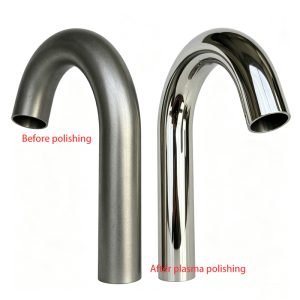
Plasma polishing represents a fundamental shift in metal finishing technology. Unlike traditional abrasive-based methods, a plasma polishing machine uses ionized plasma to interact with the metal surface at a micro level.
This process does not rely on mechanical force, which means there is no direct physical contact. Instead, controlled plasma energy selectively smooths microscopic peaks on the metal surface.
Compared with traditional polishing machine metal systems, plasma polishing delivers higher precision, cleaner surfaces, and more consistent results. It is increasingly recognized as a professional macchina per la lucidatura solution for advanced manufacturing industries.

4. Solving Complex Geometry Problems: Holes, Slots, and Dead Corners
One of the biggest limitations of traditional surface polishing machine systems is their inability to reach internal or hidden geometries.
Plasma polishing solves this problem completely. It can uniformly treat:
● Deep holes and blind holes
● Cross holes and micro channels
● Internal cavities and dead corners
Where mechanical tools fail, plasma polishing ensures uniform finishing both inside and outside the part. This makes it ideal for precision engineering components.
5. Batch Consistency: Eliminating Human and Process Variation
In traditional polishing processes, consistency is one of the hardest problems to control. Manual buffing and polishing machine operations depend heavily on operator skill, pressure control, and time judgment, which leads to unstable results.
A plasma polishing machine solves this by enabling full-batch processing in a controlled environment. Parts placed in the same chamber experience identical conditions, ensuring:
● No color difference between parts
● No random scratches or polishing marks
● No variation between batches
This level of stability makes plasma polishing a reliable solution for mass production, especially when using polishing machine suppliers that focus on industrial-grade systems.
6. Precision Deburring and Safety Improvement
Burrs are one of the most common but dangerous defects in metal parts. Traditional polishing machine metal systems often remove burrs unevenly, especially in small or hidden areas.
Plasma polishing provides automatic deburring with consistent edge rounding. This not only improves appearance but also enhances safety and assembly reliability by preventing:
● Sharp edges that cause injury
● Assembly misalignment
● Mechanical noise or blockage
Compared with conventional surface polishing machine methods, plasma technology delivers controlled and uniform edge finishing.
7. High Cleanliness Requirements: Medical, Food, and Electronics Applications
Industries such as medical devices, food equipment, and electronics require extremely high surface cleanliness. Traditional buffing and polishing machine processes often leave abrasive residues or embedded particles.
A plasma polishing machine eliminates this issue completely because it uses a non-abrasive process. The result is:
● No residue or embedded particles
● No contamination risk
● Ultra-clean surface finishing
This makes plasma polishing a preferred professional polishing machine solution for high-standard industries.
8. Deformation-Free Processing for Thin and Precision Parts
Thin-walled and precision components are easily damaged by mechanical force during traditional polishing. Pressure from buffing and polishing machine systems can lead to deformation, scratches, or structural stress.
Plasma polishing is completely non-contact. This means:
● No mechanical pressure
● No deformation or crushing
● No stress damage
It is especially suitable for micro parts, precision connectors, and lightweight structural components.

9. Corrosion Resistance and Surface Performance Enhancement
Surface roughness directly affects corrosion resistance. Traditional polishing machine metal processes often leave micro defects that accelerate rust and pitting corrosion.
Plasma polishing significantly reduces surface roughness (Ra value) and creates a more compact and passive surface layer. Benefits include:
● Improved anti-rust performance
● Better salt spray resistance
● Longer service life
This makes it ideal for harsh environment applications.
10. Cost, Automation, and Polishing Machine Price Considerations
When evaluating polishing machine price, many manufacturers focus only on initial investment. However, total cost should include labor, rejection rate, and production efficiency.
A plasma polishing machine offers:
● Reduced labor dependency
● Higher batch efficiency
● Lower defect rates
● Stable automation performance
Although polishing machine price may be higher than traditional systems, long-term ROI is significantly better, especially for mass production environments.
11. Choosing the Right Suppliers and Machines
Selecting the right polishing machine suppliers is critical for performance and stability. A professional supplier should provide:
● Industrial-grade plasma polishing machine systems
● Technical support and process guidance
● Application-specific solutions
● Reliable after-sales service
When searching for a polishing machine for sale, buyers should prioritize performance consistency over low price.
12. Future of Metal Surface Treatment
The future of metal finishing is moving away from mechanical contact systems toward intelligent, non-contact technologies.
Plasma polishing represents this shift by combining:
● Automation
● Precision control
● Environmental safety
● High consistency
It is becoming the new standard for advanced surface polishing machine technology in modern manufacturing.


 Italiano
 English
 Français
 Deutsch (Schweiz)
 Русский
 한국어