
1. Rethinking “Good Polishing”: Why Surface Quality Is More Than Just Shine
In most factories, polishing quality has traditionally been judged by one simple visual standard: brightness. The shinier the surface, the better the result—this idea has been deeply rooted in manufacturing for decades.
However, modern precision industries are redefining what “good polishing” really means. A 플라즈마 연마기 is not just improving surface appearance—it is changing the engineering definition of a finished surface.
Today, high-end industries evaluate polishing performance based on:
- Micro-level surface uniformity
- Functional smoothness (friction, sealing, wear resistance)
- Geometric stability after processing
- Consistency in mass production
This is where traditional 연마 장비 begins to show limitations. Mechanical or abrasive methods mainly “remove material physically,” which often leads to uneven micro-scratches or inconsistent edge quality.
In contrast, plasma-based surface treatment behaves more like a controlled surface reorganization process, making it part of next-generation 금속 연마 장비 rather than conventional finishing tools.
The real question is no longer “How shiny is it?”
It is: “How stable, functional, and consistent is the surface after processing?”
2. How a Plasma Polishing Machine Works (Simple Engineering Explanation)
A 플라즈마 연마기 operates using a controlled plasma field that interacts with the metal surface at a microscopic level.
Unlike traditional polishing machines that rely on abrasives, grinding wheels, or chemical corrosion, plasma polishing works through energy-driven surface smoothing.
In simple terms:
- High-energy plasma interacts with surface micro-peaks
- Elevated points are selectively “leveled”
- Surface becomes progressively smoother and more uniform
This makes plasma polishing fundamentally different from conventional polishing machine factory technologies, which are usually mechanical or chemical in nature.
Because there is no physical grinding contact, the process reduces:
- Mechanical stress
- Surface scratching
- Uneven wear patterns
This is why it is considered advanced 전문 금속 연마 장비 for precision industries.

3. Real Performance: Where Plasma Polishing Truly Outperforms
The polishing effect of a plasma system is most impressive in precision and complex geometry parts, where traditional methods fail.
3.1 Burr Removal in Complex Structures
Plasma polishing can remove micro burrs inside:
- Blind holes
- Cross holes
- Deep cavities
- Micro channels
Unlike conventional 금속 연마 장비, it does not require direct tool access.
3.2 Uniform Edge Rounding
Edges are automatically smoothed into consistent R-radius profiles.
This improves:
- Assembly safety
- Sealing performance
- Handling comfort
Batch consistency is extremely high, which is difficult for mechanical polishing.
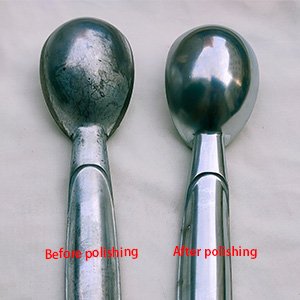
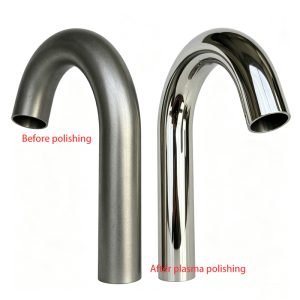
3.3 Mirror-Like Surface Quality
For stainless steel and precision alloys, surface roughness can reach:
- Ra 0.05–0.4 μm
The result:
- 스크래치 없음
- No grinding marks
- Uniform brightness across batches
3.4 Complex Geometry Coverage
Plasma polishing works equally well on:
- Threaded parts
- Gear structures
- Irregular shapes
- Deep internal cavities
This is where traditional 연마 장비 typically fails.
3.5 Dimensional Stability
Material removal is extremely minimal and controllable:
- 변형 없음
- No dimensional drift
- High batch repeatability
This is critical for aerospace and medical industries.
4. When Plasma Polishing Is NOT Ideal
Despite its advantages, plasma polishing is not universal.
It is less effective in:
- Extremely rough cast or forged surfaces
- Thick oxide scale removal scenarios
- Large flat plate polishing (cost inefficiency)
- Non-conductive materials
- Zero-material-removal requirements
In these cases, traditional 연마 장비 may still be more economical.
5. Plasma Polishing vs Traditional Metal Polishing Equipment
Compared with traditional 금속 연마 장비, plasma polishing offers a completely different philosophy:
- Mechanical polishing = physical abrasion
- Vibratory finishing = collision-based smoothing
- Plasma polishing = energy-based surface refinement
Key difference:
Traditional systems depend on force, while plasma systems depend on controlled surface energy interaction.
This is why many polishing machine manufacturer companies are now investing in plasma technology to meet precision industry demands.
6. Industry Applications: Where Plasma Polishing Becomes Irreplaceable
The true value of a 플라즈마 연마기 is not just in laboratory results, but in real industrial scenarios where traditional processes fail to deliver consistency.
6.1 Medical Industry: Zero-Tolerance Surface Quality
In medical devices, surface defects are not just cosmetic—they directly impact safety.
Plasma polishing ensures:
- No micro-burrs that can damage tissue
- Smooth surfaces that resist bacterial adhesion
- Easy sterilization
This makes it essential 전문 금속 연마 장비 in surgical and implant manufacturing.
6.2 Aerospace Components: Precision Over Everything
Aerospace parts demand extreme dimensional control.
Plasma polishing provides:
- No deformation during processing
- Stable tolerances
- Uniform treatment in complex geometries
전통 금속 연마 장비 often introduces stress or inconsistency, which is unacceptable in this field.
6.3 Automotive Precision Parts
Fuel injection systems, valve components, and micro metal parts require:
- Burr-free internal channels
- Consistent edge finishing
- 높은 반복성
A modern polishing machine manufacturer will often recommend plasma solutions for these critical components.
6.4 High-End Consumer Hardware
Products like:
- Premium stainless steel accessories
- Smart device components
- Decorative precision metal parts
All require:
- Uniform gloss
- High-end tactile feel
- Scratch-free surfaces
This is where plasma polishing defines perceived product quality.
7. Why More Factories Are Switching to Plasma Polishing
The adoption of plasma polishing is not a trend—it is a manufacturing upgrade driven by economics and quality control.
7.1 Labor Reduction
Traditional polishing relies heavily on skilled workers.
Plasma systems:
- Reduce manual intervention
- Lower labor cost
- Improve process stability
7.2 Consistency in Mass Production
One of the biggest challenges in traditional polishing is variation.
Plasma polishing ensures:
- Identical results across batches
- No operator-dependent differences
7.3 Process Integration
현대 polishing machine factory systems are designed to integrate into automated production lines.
This allows:
- Continuous processing
- Reduced cycle time
- Higher throughput
7.4 Cost Efficiency Over Time
Although initial investment is higher, long-term benefits include:
- Reduced rework
- Lower defect rates
- Higher product value

8. How to Choose the Right Plasma Polishing Machine Manufacturer
올바른 선택 polishing machine manufacturer is more important than choosing the machine itself.
8.1 Process Capability Over Specs
Do not focus only on machine parameters.
Instead, evaluate:
- Actual polishing results
- Sample testing capability
- Experience with similar parts
8.2 Customization Ability
A reliable polishing machine factory should provide:
- Process tuning
- Fixture design
- Parameter optimization
8.3 Technical Support
After-sales support determines long-term success.
Look for:
- Process training
- Troubleshooting support
- Continuous optimization
8.4 Industry Experience
Manufacturers with experience in:
- Medical
- 항공우주
- Precision hardware
Are more likely to deliver stable solutions.
9. Final Conclusion: Is the Polishing Effect of a Plasma Polishing Machine Good?
The answer is clear:
Yes—but only if you evaluate polishing from a modern engineering perspective.
A 플라즈마 연마기 does not just improve surface appearance. It delivers:
- Functional surface enhancement
- Precision-level consistency
- Capability for complex structures
- Stable mass production performance
Compared to traditional 연마 장비, it represents a shift from manual craftsmanship to controlled engineering systems.
For manufacturers dealing with:
- 정밀 부품
- Complex geometries
- High-quality standards
Plasma polishing is no longer optional—it is becoming the new industrial standard in professional metal polishing equipment.


 한국어
 English
 Français
 Deutsch (Schweiz)
 Italiano
 Русский