
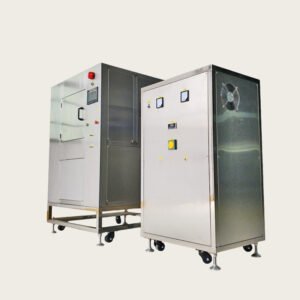
In today’s manufacturing landscape, metal products are everywhere—from the sleek 3C devices in our hands and exquisite tableware to automotive components and aerospace parts. Their surface quality directly determines aesthetics, corrosion resistance, wear resistance, and even service life. To achieve ultimate surface smoothness or even a mirror finish, polishing has become an indispensable step. However, faced with increasingly complex workpiece shapes and stringent environmental regulations, traditional polishing methods are struggling to keep up. It is against this backdrop that the 플라즈마 연마기 has emerged—not merely as a technological upgrade, but as a green revolution in metal surface treatment.
1. Why Did Plasma Polishing Machines Emerge? – The Dilemma of Traditional Processes
For decades, manufacturing has relied on mechanical polishing, chemical polishing, and electrolytic polishing. While these traditional methods have played a vital role historically, their inherent drawbacks are increasingly becoming bottlenecks for business development.
-
High Health and Environmental Costs: Traditional mechanical polishing generates large amounts of metal dust during production, posing a serious threat to the respiratory health of workers. Chemical and electrolytic polishing, on the other hand, depend heavily on large quantities of corrosive chemicals such as strong acids and alkalis. These substances are not only hazardous themselves, but the wastewater they produce is difficult and expensive to treat, easily leading to environmental pollution.
-
Helplessness with Complex Workpieces: As product designs become more intricate and precise, the number of workpieces featuring complex patterns, deep holes, internal cavities, or irregular curved surfaces is increasing. Traditional manual or mechanical polishing often can only handle external surfaces; when it comes to dead corners, inner walls, and recessed areas of a workpiece, these methods are powerless to achieve a uniformly glossy finish across the entire surface.
-
Dual Bottlenecks of Efficiency and Precision: Traditional polishing relies heavily on the operator’s experience, resulting not only in low efficiency (a single worker’s daily output is limited) but also in inconsistent product precision and quality. For extremely small workpieces (e.g., less than 1 cm) or applications requiring ultra-high precision (such as aerospace components), traditional methods are often completely unsuitable.
It is under the urgent demand for a polishing technology that is high-efficiency, high-precision, low-cost, and environmentally friendly that plasma polishing technology has moved from the laboratory to industrial application.


2. What Problems Can a Plasma Polishing Machine Solve? – Principles and Core Value
Plasma polishing technology, especially metal electrolytic plasma polishing, cleverly utilizes the physical properties of plasma. The principle can be described as follows: The metal workpiece is immersed in a low-concentration neutral salt solution (polishing fluid), and a specific DC voltage is applied. Under the high voltage, the polishing fluid around the workpiece instantly vaporizes, forming a stable gas layer (plasma sheath). This gas layer ionizes under the influence of the electric field, generating discharge channels that selectively remove microscopic protrusions, burrs, and impurities from the workpiece surface, achieving rapid polishing, cleaning, and passivation.
This technology precisely addresses the pain points of traditional processes:
-
Solves the “Hard-to-Polish” Problem: Because the polishing process occurs through the gas layer surrounding the workpiece, regardless of how complex the workpiece shape is (e.g., slender tubes with an inner diameter of 0.6 mm, precision aerospace filters), the plasma can penetrate everywhere, achieving uniform polishing over the entire surface, including interiors and死角 (hard-to-reach areas).
-
Solves the “Low Quality” Problem: It not only removes burrs from stamping and residues (yellow spots, dark marks) from laser/etching processes but also generates a dense passive film on the workpiece surface during polishing, significantly enhancing corrosion resistance and preventing oxidation.
-
Solves the “Heavy Pollution” Problem: The polishing fluid used is a non-toxic, harmless low-concentration salt solution, posing almost no environmental risk. Wastewater can even be discharged directly or simply recycled after treatment, fundamentally overturning the high-pollution model of traditional acid-based polishing.
3. The “Overwhelming” Advantages of Plasma Polishing Compared to Traditional Methods
Compared to traditional polishing methods, plasma polishing machines demonstrate comprehensive advantages—this is not just an optimization of parameters, but a leap in dimensionality.
1. Leap in Efficiency
What takes hours with traditional processes can often be completed in just tens of seconds to a few minutes with plasma polishing. For example, one case study shows that a process originally requiring several hours for polishing was completed in only 30 seconds using plasma liquid nano-polishing technology. The daily output of a single machine can exceed 20,000 pieces, which is several times or even dozens of times higher than traditional manual polishing. Compared to mechanical polishing, production efficiency and economic benefits can increase by 5-6 times, and even compared to more advanced acid-based polishing, it can improve by 3-4 times.
2. Ultimate Precision
Traditional mechanical polishing, limited by contact stress and tool wear, easily causes surface and subsurface damage to the workpiece and has limited precision. Plasma polishing is a 비접촉 프로세스, removing material through atomic-level chemical etching or physical discharge, generating almost no processing stress and eliminating surface damage. Its polishing precision is extremely high, with minimal dimensional impact (typically controllable to 0.1 microns per minute), and it can reduce surface roughness (Ra) to 0.2μm or even as low as 0.01μm, meeting the nanoscale manufacturing requirements of high-end fields such as aerospace and medical devices.
3. Unification of Environmental Friendliness and Cost
-
친환경: Uses neutral salt solutions, completely abandoning the strong acids, strong alkalis, and heavy metal pollution of traditional processes—a truly “green technology.”
-
Cost-effective: Although the initial equipment investment may be higher, its overall operating costs are significantly lower. On one hand, it greatly reduces dependence on highly skilled polishing workers, lowering expensive labor costs. On the other hand, chemical consumption is extremely low, and the substantial expenses for environmental treatment are eliminated.
4. Wide Applicability
In terms of materials, it can polish not only common metals like stainless steel, carbon steel, aluminum alloy, and copper alloy, but also refractory metals such as titanium alloy. In terms of applications, it has demonstrated excellent processing capabilities ranging from tiny mobile phone buttons and precision screens to the inner walls of metal capillary tubes several meters long, and even aerospace engine turbine blades.
결론
The emergence of the plasma 연마기 is no accident. It is the inevitable result of the manufacturing industry facing the dual pressures of health and environmental red lines and the demands of precision manufacturing. This ultra-precision technology, once a bottleneck for countries lacking it, is now proving its powerful capabilities through widespread applications in industries like screen manufacturing, medical devices, and aerospace. It not only solves the historical problems of traditional polishing—dirtiness, labor-intensiveness, danger, and difficulty—but with its high efficiency, high precision, and green nature, it is becoming an important benchmark for measuring a country’s advanced manufacturing level. Plasma polishing is leading the metal surface treatment industry into a new era.



 한국어
 English
 Français
 Deutsch (Schweiz)
 Italiano
 Русский