
Chapter 1: Titanium Alloy Is Not Difficult Because It Is Hard — It Is Difficult Because It Is “Sensitive”
Titanium alloy has long been considered one of the most challenging materials in surface finishing. Interestingly, the difficulty does not mainly come from its hardness. In fact, many hardened steels are mechanically tougher than titanium. The real challenge lies in titanium’s extreme sensitivity during surface treatment.
Unlike ordinary metals, titanium reacts with oxygen almost instantly. The moment fresh titanium is exposed to air, a dense oxide layer forms on the surface. This passive film protects the metal from corrosion, which is excellent for aerospace and medical applications, but problematic for conventional polishing. Many traditional polishing processes only scratch the oxide layer without truly refining the underlying surface. As a result, operators often experience dull finishes, unstable gloss, or uneven coloring when polishing titanium.
Traditional mechanical polishing creates another major issue: heat accumulation. Titanium has very poor thermal conductivity compared with steel or copper alloys. During polishing titanium, heat cannot dissipate quickly, causing localized temperature spikes. Once the temperature exceeds a critical point, the surface may turn yellow, blue, or cloudy. This is one reason why achieving stable mirror polish titanium results is notoriously difficult with conventional abrasive methods.
Mechanical polishing also introduces physical stress onto the workpiece. For thin-wall titanium structures, medical implants, or precision aerospace parts, even minor deformation can lead to product failure. In industries where dimensional accuracy matters at the micron level, this becomes unacceptable.
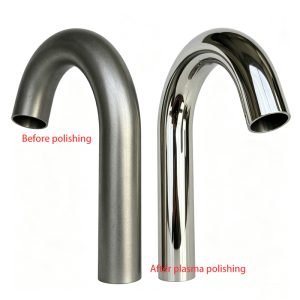
This is where plasma polishing technology begins to change the game. Unlike abrasive polishing, plasma polishing does not rely purely on mechanical friction. Instead, it uses controlled electrochemical energy and plasma reactions to gradually smooth microscopic peaks on the metal surface. Because the process removes material at a microscopic and highly uniform level, polished titanium surfaces become significantly smoother and more consistent.
However, many newcomers misunderstand plasma polishing and assume the process is universal across all metals. This is a dangerous misconception. Titanium polishing requires dedicated electrolytes, carefully tuned current curves, temperature management, and timing control. Parameters used for stainless steel or zinc alloy can easily damage titanium surfaces. A professional plasma polishing machine designed for titanium must therefore provide much more precise process control than standard polishing equipment.
Another overlooked fact is that titanium polishing is no longer only about appearance. In medical and aerospace industries, surface quality directly affects corrosion resistance, fatigue life, biological compatibility, and cleanliness standards. A poorly controlled polishing process may look visually acceptable while still failing functional requirements. This is why advanced titanium polishing services invest heavily in process validation rather than simply increasing polishing speed.
In other words, titanium plasma polishing is not difficult because titanium is impossible to polish. It is difficult because titanium demands process precision. Once the correct plasma polish parameters are established, the process actually becomes highly repeatable and remarkably stable for mass production.

Chapter 2: Plasma Polishing Technology Changes the Logic of Titanium Surface Finishing
For decades, the metal finishing industry approached polishing as a purely mechanical task. The basic idea was simple: use abrasive force to gradually smooth the surface. This logic works reasonably well for aluminum, stainless steel, and copper alloys. However, titanium behaves differently. Its sensitivity to heat, friction, and surface contamination means that traditional polishing methods often create more problems than they solve.
This is why plasma polishing technology is not merely an upgraded polishing method — it represents an entirely different philosophy of surface treatment.
Plasma Polishing Is About Surface Energy Control, Not Surface Grinding
The biggest difference between plasma polishing and traditional polishing lies in how material is removed. Mechanical polishing depends on physical contact. Abrasive particles continuously scratch the metal surface until rough peaks are flattened. While effective in some cases, this approach creates unavoidable mechanical stress and microscopic damage.
Plasma polishing works differently. During the process, the titanium component is immersed in a specialized electrolyte while electrical energy creates a plasma envelope around the surface. Instead of aggressively grinding the material, the process selectively removes microscopic protrusions at the atomic level. The energy distribution naturally targets surface peaks first, producing an extremely uniform finish.
This is why polished titanium produced by plasma technology often appears smoother and brighter than surfaces treated by conventional abrasive polishing.
Why Mirror Polish Titanium Is Easier with Plasma Technology
Many manufacturers assume achieving mirror polish titanium requires increasingly finer abrasive compounds. In reality, excessive mechanical polishing often introduces secondary scratches invisible to the naked eye. Under microscopes, these surfaces still contain irregular grooves and directional polishing lines.
Plasma polish eliminates this limitation because the process is non-directional. There is no polishing wheel dragging across the surface, no uneven pressure from operators, and no random abrasive contamination. Instead, the material removal process occurs uniformly across the entire exposed area.
As a result, polishing titanium to mirror finish becomes more controllable, especially for precision components that demand optical-level smoothness. In many cases, titanium polishing mirror finish quality can be achieved with significantly fewer process steps compared with conventional polishing.
Why Complex Titanium Structures Benefit the Most
One of the biggest weaknesses of mechanical polishing is accessibility. Traditional polishing tools struggle with internal cavities, blind holes, lattice structures, sharp corners, and ultra-thin sections. Operators often spend hours manually polishing difficult areas, yet consistency still remains poor.
This limitation becomes severe in industries such as aerospace and medical manufacturing, where titanium parts are becoming increasingly complex. Modern implants, orthopedic components, surgical instruments, and lightweight aerospace brackets often contain intricate internal geometries impossible to polish mechanically.
Plasma polishing technology solves this issue naturally because the plasma reaction surrounds the entire conductive surface. Even internal channels and hidden corners can be polished simultaneously. In many applications, plasma polishing can complete deburring and surface finishing in a single operation.
This capability has made titanium polishing services increasingly attractive for manufacturers producing high-value precision components.
Plasma Polishing Is Also Changing Production Economics
Another reason plasma polishing is gaining popularity is its impact on manufacturing efficiency. Traditional titanium polishing is labor-intensive, highly dependent on operator skill, and difficult to standardize. Different workers may produce completely different surface qualities on the same part.
By contrast, a modern plasma polishing machine can automate large portions of the process. Once parameters such as current density, electrolyte composition, temperature, and polishing time are optimized, production consistency improves dramatically.
For manufacturers pursuing scalable production, this is transformative. Instead of relying on polishing craftsmanship alone, companies can establish repeatable digital process control. This is one reason many factories now source advanced titanium polishing machine systems from experienced polishing machine manufacturer companies, especially from leading polishing machine china suppliers capable of offering customized process integration.
Chapter 3: The Biggest Misunderstanding — “Titanium Cannot Be Brightly Polished”
One of the most common myths in the metal finishing industry is that titanium simply cannot achieve a true mirror finish. Many manufacturers believe titanium will always appear grayish, cloudy, or slightly matte compared with stainless steel. This misunderstanding has existed for years, largely because many companies use incorrect polishing methods or unstable process parameters.
In reality, titanium can achieve an exceptionally bright and highly reflective surface. The problem is not the material itself — the problem is process instability.
Why Titanium Surfaces Turn Yellow, Blue, or Cloudy
When operators first attempt polishing titanium, discoloration is one of the earliest problems they encounter. Some parts develop blue patches, others turn yellow or rainbow-colored, while some lose reflectivity entirely and become hazy.
These defects are often misunderstood as unavoidable properties of titanium. However, they are actually signs of poor process balance.
Titanium reacts very sensitively to temperature changes. Even small thermal fluctuations can alter the thickness of the oxide layer on the surface. Because light reflects differently through varying oxide thicknesses, visible color changes begin to appear. This is similar to heat discoloration seen in welded titanium components.
In unstable plasma polish processes, excessive current density, weak cooling systems, or inconsistent electrolyte composition can rapidly create localized overheating. Once the surface temperature exceeds the safe process window, the polished titanium surface may lose uniformity within seconds.
More Power Does Not Mean Better Titanium Polishing
A major mistake made by inexperienced operators is assuming higher voltage automatically produces brighter surfaces. This idea comes from traditional mechanical thinking: stronger polishing equals faster results.
But plasma polishing technology behaves differently.
Titanium requires a very narrow processing window. If energy input is too low, the oxide layer remains intact and the surface stays dull. If energy input is too high, the surface becomes unstable and begins to discolor. The ideal polishing zone exists in a carefully balanced middle range.
This is why advanced titanium polishing machine systems focus heavily on dynamic current control instead of raw output power. The best polishing results often come from highly stable electrical curves rather than aggressive energy levels.
In professional titanium polishing services, engineers frequently spend weeks optimizing process recipes for a single titanium alloy grade. Different titanium compositions respond differently to plasma energy, electrolyte chemistry, and thermal conditions.
The Real Secret Behind Mirror Polish Titanium
Many people focus entirely on the polishing equipments itself, but the true secret behind mirror polish titanium is process coordination.
A successful titanium polishing process requires all variables to work together:
- Electrolyte composition
- Temperature stability
- Current waveform
- Surface preparation
- Part geometry
- Processing duration
- Agitation and circulation systems
If even one factor becomes unstable, the final finish quality may collapse.
This is why two factories using similar plasma polishing machine equipment can achieve completely different results. One factory may consistently produce flawless titanium polishing mirror finish surfaces, while another struggles with haze and discoloration.
The difference usually lies in process engineering knowledge rather than machine appearance.
Why High-End Industries Trust Plasma Polishing More Than Ever
As titanium applications continue expanding, industries are demanding increasingly precise surface quality standards. Aerospace manufacturers require flawless fatigue resistance. Medical companies require ultra-clean surfaces with excellent biocompatibility. Semiconductor industries demand contamination-free titanium components.
Under these conditions, traditional polishing methods become increasingly difficult to control.
Plasma polishing technology offers something modern manufacturing values deeply: repeatability. Once optimized, the process can deliver highly stable surface quality across thousands of identical components. This consistency is extremely difficult to achieve with manual mechanical polishing.
That is why more manufacturers are investing in automated plasma polishing machine systems from experienced polishing machine manufacturers, especially companies specializing in china polishing machine production and custom titanium finishing solutions.

Chapter 4: Why Plasma Polishing Machine Design Determines Titanium Results
Many companies entering the titanium polishing industry focus almost entirely on process parameters. They discuss voltage, polishing time, or electrolyte formulas, believing these are the only keys to success. While these factors are important, they overlook a deeper reality: even the best process recipe can fail on the wrong machine.
In titanium plasma polishing, machine architecture directly affects surface stability, heat distribution, electrolyte behavior, and ultimately the final mirror quality. This is why some factories can consistently produce flawless mirror polish titanium surfaces while others struggle with discoloration and inconsistency using seemingly similar settings.
Not Every Plasma Polishing Machine Is Designed for Titanium
One of the biggest misconceptions in the market is the belief that any plasma polishing machine can process titanium effectively. In reality, many low-cost systems are originally optimized for stainless steel or general metals. When these machines are used for titanium, hidden design weaknesses quickly become obvious.
Titanium requires exceptionally stable energy delivery. Minor fluctuations in current density can immediately create uneven surface reactions. Unfortunately, many entry-level systems suffer from unstable power output, poor electrical response speed, or insufficient waveform control.
As a result, operators may experience:
- Uneven brightness
- Surface haze
- Local overheating
- Blue or yellow oxidation marks
- Inconsistent titanium polished textures
This is why professional titanium polishing machine systems often include advanced power modules specifically designed for reactive metals like titanium.
Temperature Control Is the Invisible Core of Titanium Polishing
When discussing plasma polishing technology, many people focus on electrical systems while ignoring temperature management. However, for titanium, thermal stability is often more important than power itself.
Titanium’s poor thermal conductivity means heat accumulates rapidly on the surface during processing. If electrolyte temperature rises uncontrollably, the plasma layer becomes unstable, chemical reactions accelerate unpredictably, and surface discoloration begins to appear.
High-end plasma polishing machine systems therefore invest heavily in cooling architecture:
- Multi-stage heat exchangers
- Electrolyte circulation systems
- Intelligent thermal monitoring
- Dynamic cooling adjustment
- Stable liquid flow distribution
These systems ensure that every titanium component experiences nearly identical thermal conditions during processing.
Without precise cooling, even a good electrolyte formula may fail to produce stable titanium polishing mirror finish results.
Intelligent Current Control Is Reshaping Plasma Polish Quality
Older polishing systems usually operate using fixed electrical settings. While this may work for simple materials, titanium surfaces are highly dynamic during plasma polishing. As the oxide layer changes thickness and conductivity during processing, the energy demand also changes continuously.
Modern plasma polishing machine systems increasingly use adaptive current control technology. Instead of maintaining a rigid output, intelligent systems dynamically adjust current behavior according to real-time process conditions.
This creates several major advantages:
- More stable plasma formation
- Reduced oxidation risk
- Improved mirror consistency
- Lower defect rates
- Better repeatability in mass production
For advanced polishing titanium applications, adaptive electrical control has become one of the defining technologies separating industrial-grade systems from basic machines.
Why Global Buyers Are Looking Toward China Polishing Machine Manufacturers
Over the past decade, China has become one of the world’s fastest-growing centers for advanced surface finishing equipment. Many international manufacturers now source plasma polishing machine systems from experienced polishing machine china suppliers.
This shift is not only about price advantage. Modern Chinese polishing machine manufacturer companies increasingly offer:
- Customized titanium polishing solutions
- Integrated automation systems
- Flexible production line design
- Rapid engineering support
- Competitive process development capabilities
In particular, many polishing machine manufacturers now combine equipment production with in-house process laboratories. This allows customers to receive both machinery and optimized plasma polishing technology solutions together.
For buyers entering the titanium polishing industry, this integrated approach significantly reduces development risk and shortens production startup time.
Chapter 5: Plasma Polishing vs Mechanical Polishing for Titanium
For years, mechanical polishing dominated the titanium finishing industry. Skilled workers used abrasive wheels, polishing paste, and repeated grinding steps to improve surface smoothness. While this method still exists today, the rise of plasma polishing technology is fundamentally changing how manufacturers evaluate surface finishing quality.
The comparison between these two technologies is no longer simply about brightness. Modern industries now focus on consistency, stress control, corrosion resistance, microstructure integrity, and production scalability.
Mechanical Polishing Creates Smoothness Through Force
Traditional polishing titanium relies on abrasive contact. The polishing wheel physically cuts away surface peaks until the material becomes smoother. In experienced hands, this method can achieve visually attractive surfaces.
However, the process has several hidden limitations.
Every contact-based polishing operation creates directional scratches, microscopic tearing, and residual stress beneath the surface. Even when the titanium appears bright to the naked eye, microscopic inspection often reveals irregular polishing lines and damaged grain structures.
For decorative applications, these defects may be acceptable. But in aerospace, medical, and semiconductor industries, microscopic surface integrity directly affects product performance.
Plasma Polish Produces Surface Uniformity at the Microscopic Level
Unlike abrasive polishing, plasma polish removes material using controlled electrochemical energy. Because there is no direct grinding contact, the surface experiences significantly less mechanical damage.
The result is a more uniform titanium polished surface with fewer directional defects.
Under microscopic analysis, plasma polishing technology often produces:
- Lower surface roughness
- More consistent reflection
- Reduced microcracks
- Minimal residual stress
- Better edge retention
This is particularly important for precision titanium components where fatigue resistance and corrosion stability matter more than simple cosmetic appearance.
Why Plasma Polishing Is Better for Thin-Wall Titanium Parts
Thin titanium structures are notoriously difficult to polish mechanically. Excessive grinding pressure can easily deform edges, damage delicate structures, or reduce dimensional accuracy.
This problem becomes critical in:
- Medical implants
- Aerospace brackets
- Titanium mesh structures
- Micro-components
- Hollow precision parts
Plasma polishing technology solves this challenge because it is essentially stress-free. The process does not force abrasive pressure onto the workpiece, allowing polishing titanium without deformation risks.
This capability has made plasma polishing machine systems increasingly popular in advanced manufacturing industries.
Corrosion Resistance Improves After Plasma Polishing
Another major advantage of titanium metal polish using plasma technology is improved corrosion resistance.
Mechanical polishing can sometimes leave embedded abrasive particles or unstable surface layers. These microscopic contaminants may later become corrosion initiation points.
Plasma polishing, by contrast, produces a cleaner and more chemically stable surface. The controlled surface reaction helps optimize the titanium oxide layer, improving long-term corrosion resistance and biological compatibility.
This is especially valuable for:
- Surgical implants
- Medical instruments
- Marine titanium parts
- Chemical processing equipment
- Aerospace systems exposed to harsh environments
In many applications, plasma-polished titanium surfaces outperform mechanically polished parts in long-term durability testing.

Chapter 6: The Rise of Medical and Aerospace Titanium Polishing
The demand for titanium polishing is growing rapidly across high-end industries. In the past, titanium was mainly associated with aerospace engineering. Today, it is also widely used in medical devices, precision electronics, new energy systems, and advanced industrial equipment.
As applications become more demanding, surface finishing standards are becoming stricter than ever. This is one reason plasma polishing technology is gaining global attention.
Medical Titanium Requires Ultra-Clean Surfaces
Medical-grade titanium components must meet extremely strict cleanliness and biocompatibility standards.
For implants and surgical instruments, surface defects are not merely cosmetic problems. Tiny scratches, embedded particles, or contamination can influence tissue compatibility, bacterial adhesion, and long-term implant stability.
Traditional polishing methods often struggle to eliminate microscopic contamination completely.
Plasma polishing technology provides a major advantage because it simultaneously smooths and cleans the titanium surface. The resulting titanium polished layer becomes more uniform and biologically stable.
This is why titanium polishing services for medical industries increasingly rely on advanced plasma polishing machine systems.
Aerospace Titanium Components Demand Zero Defects
Aerospace manufacturing pushes titanium finishing standards to an extreme level.
Aircraft and spacecraft components experience:
- High temperatures
- Continuous vibration
- Cyclic stress loading
- Corrosive environments
- Extreme fatigue conditions
Under these conditions, even microscopic surface defects can become crack initiation points.
Mechanical polishing sometimes introduces residual stress and hidden surface damage, which may reduce fatigue resistance over time.
Plasma polishing technology minimizes these risks by producing stress-free and highly uniform surfaces. This improves fatigue life while preserving dimensional precision.
For aerospace manufacturers, stable mirror polish titanium quality is not about appearance — it is about long-term operational safety.
Chapter 7: How to Choose the Best Titanium Polishing Machine
Choosing the right titanium polishing machine is no longer just about equipment price. As titanium applications become more advanced, manufacturers must evaluate process stability, automation capability, thermal management, and long-term reliability.
Many companies make the mistake of purchasing low-cost systems first, only to discover later that unstable polishing quality creates far greater production losses.
A Good Titanium Polishing Machine Must Prioritize Stability
For titanium processing, stability is more important than peak power.
A professional plasma polishing machine should include:
- Stable power delivery
- Intelligent temperature control
- Efficient electrolyte circulation
- Real-time monitoring systems
- Adaptive current management
- Industrial automation compatibility
Without these features, achieving consistent titanium polishing mirror finish results becomes extremely difficult.
Why Process Experience Matters More Than Advertising
Many polishing machine manufacturers promote impressive technical specifications, but real titanium polishing performance depends heavily on practical process experience.
An experienced polishing machine manufacturer understands:
- Different titanium alloy behaviors
- Electrolyte compatibility
- Surface roughness optimization
- Thermal balance control
- Production consistency challenges
This engineering knowledge often matters more than simple machine appearance.
Chapter 8: Future Trends — Titanium Polishing Is Becoming More Intelligent
The titanium finishing industry is entering a new era. In the past, polishing relied heavily on operator experience and manual adjustments. Today, automation and intelligent control are rapidly transforming the entire plasma polishing technology landscape.
AI-Assisted Process Optimization
Modern plasma polishing machine systems are beginning to integrate AI-based monitoring technologies.
Future systems may automatically analyze:
- Surface temperature
- Plasma stability
- Current fluctuations
- Electrolyte condition
- Surface reflectivity
The machine can then dynamically adjust process parameters in real time, reducing operator dependence and improving production consistency.
Green Manufacturing Is Becoming Essential
Environmental regulations are becoming stricter worldwide. As a result, eco-friendly plasma polishing technology is becoming a major industry trend.
Future titanium polishing systems will increasingly focus on:
- Low-consumption electrolytes
- Waste recycling
- Energy-efficient processing
- Reduced emissions
- Cleaner production environments
This transition is especially important for medical and aerospace industries where environmental compliance standards continue rising.
Conclusion: Titanium Plasma Polishing Is Difficult Only Before the Process Is Mastered
Titanium alloy plasma polishing does have a technical barrier. The material’s sensitivity to temperature, energy, and chemical reactions makes the process far more demanding than ordinary metal polishing.
However, difficulty does not mean impossibility.
Once dedicated plasma polishing technology, specialized electrolytes, and optimized process parameters are established, titanium polishing becomes highly controllable and remarkably stable for mass production.
Compared with traditional polishing methods, plasma polishing offers:
- Better surface consistency
- Stress-free finishing
- Superior corrosion resistance
- Cleaner surfaces
- Better complex-structure processing capability
- Improved automation potential
As high-end industries continue demanding higher precision and cleaner surfaces, plasma polishing is rapidly becoming one of the most important technologies in modern titanium manufacturing.


 English
 Français
 Deutsch (Schweiz)
 Italiano
 Русский
 한국어