
1. Introduction: The Fear Behind Advanced Finishing Technologies
In modern manufacturing, surface finishing is no longer just about appearance—it directly impacts performance, durability, and product value. Yet, when companies first encounter Plasmapolieren, a common concern arises: Will this advanced process damage my product?
This concern is understandable. Any process involving energy, electricity, and chemical reactions sounds inherently aggressive. However, this assumption often comes from comparing plasma-based methods to traditional mechanical polishing—which relies heavily on physical force.
In reality, Plasma-Poliertechnik represents a shift from force-driven finishing to controlled energy-based refinement, offering a fundamentally different—and often safer—approach.
2. What Is Plasma Polishing? (Beyond the Basics)
Plasmapolieren is an advanced surface finishing process that uses an electrochemical plasma layer to remove microscopic surface irregularities. Unlike conventional polishing, there are no abrasive tools, no direct contact, and no mechanical pressure.
Closely related processes include plasma electrolytic polishing und plasma electropolishing, both of which rely on controlled electrical energy to create a plasma envelope around the workpiece.
A modern Plasmapoliermaschine precisely regulates voltage, electrolyte composition, and temperature—ensuring consistent, repeatable, and highly controlled results.
3. The Core Mechanism: Why Plasma Polishing Is Inherently Gentle
The key to understanding why plasma electropolishing does not damage products lies in its selective micro-removal mechanism.
Instead of grinding down the entire surface, plasma energy targets only microscopic peaks, burrs, and sharp edges. The base surface remains largely untouched because it experiences significantly lower energy density.
This creates a self-regulating effect:
- High points are removed faster
- Flat areas are preserved
- No mechanical stress is introduced
In essence, the process behaves more like surface leveling than material removal.
4. Does Plasma Polishing Damage Products? The Short Answer
No—under proper operating conditions, plasma polishing does not damage products.
In fact, compared to traditional methods, it is often significantly safer. The absence of mechanical contact eliminates risks such as scratches, deformation, and inconsistent finishes.
However, like any advanced process, it is parameter-sensitive. Damage is not caused by the technology itself, but by improper use.

5. A New Perspective: “Selective Removal” Instead of “Material Destruction”
One of the biggest misconceptions about Plasmapolieren is that it “removes material aggressively.” In reality, the process is better understood as selective surface correction rather than material destruction.
Unlike traditional polishing methods that treat the entire surface equally, plasma electrolytic polishing behaves intelligently at the microscopic level. It prioritizes the removal of surface peaks, burrs, and irregularities, while leaving the bulk structure intact. This means the dimensional integrity of the product is largely preserved.
This concept fundamentally changes how we define “damage.” In conventional processes, removing material often leads to rounding edges, altering dimensions, or weakening structural features. However, with plasma electropolishing, the removal is so controlled that it enhances surface quality without compromising geometry.
In fact, many manufacturers now consider Plasma-Poliertechnik as a corrective process rather than a subtractive one. It improves smoothness, reduces stress concentration points, and enhances corrosion resistance—all without introducing new defects.
From this perspective, plasma polishing is not a risk to product integrity—it is a tool for precision refinement at the micro scale.
6. Comparing Risks: Plasma vs Mechanical vs Manual Polishing
To truly evaluate whether Plasmapolieren damages products, it is essential to compare it with traditional finishing methods.
Das mechanische Polieren beruht auf direct contact between abrasive tools and the workpiece. This introduces risks such as scratches, uneven material removal, and even deformation—especially for thin or delicate components. Manual polishing further amplifies these risks due to operator inconsistency, fatigue, and lack of precision.
In contrast, plasma electropolishing eliminates physical contact entirely. There are no grinding wheels, no abrasive particles, and no mechanical pressure applied to the surface. This dramatically reduces the chances of localized damage.
Additionally, traditional methods often struggle with complex geometries such as inner holes, sharp corners, and intricate patterns. Plasma processes, powered by electrical fields, can uniformly treat these areas without causing stress concentration or missed spots.
From a risk perspective, plasma Poliermaschine systems provide a more predictable, repeatable, and controlled environment. The variability caused by human factors is minimized, making it especially suitable for high-precision industries.
Ultimately, when properly controlled, plasma polishing offers lower overall risk compared to mechanical and manual methods.
7. When Can Plasma Polishing Actually Damage a Product?
Although Plasmapolieren is inherently safe, improper operation can still lead to defects. Understanding these scenarios is critical for preventing damage.
One of the most common issues is over-processing. If the polishing time is too long, excessive material removal may occur, leading to dimensional changes such as thinner walls or enlarged holes.
Another key factor is incorrect voltage or power settings. Soft metals like aluminum, copper, and zinc alloys are particularly sensitive. Excessive energy input can cause over-corrosion, surface pitting, or discoloration.
Poor electrical contact is another hidden risk. If the fixture does not provide stable conductivity, localized sparking may occur, resulting in burn marks or micro-craters.
In addition, improper pre-treatment—such as inadequate degreasing—can cause uneven polishing, leaving stains or cloudy surfaces. Electrolyte imbalance (temperature or concentration) may also lead to inconsistent results.
In summary, damage is not caused by Plasma-Poliertechnik itself, but by lack of process control.
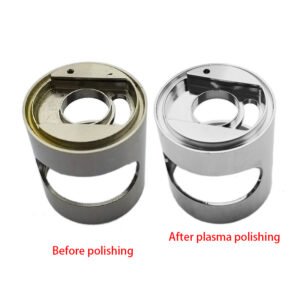
8. Material-Specific Safety Analysis
Different materials respond differently to Plasmapolieren, but most can be processed safely with proper parameter control.
Stainless steel is one of the most stable materials for plasma electropolishing. It achieves excellent brightness and smoothness without compromising structural integrity, making it ideal for precision and medical applications.
Thin-walled and complex components benefit significantly from plasma processing. Since there is no mechanical stress, even delicate geometries remain intact.
For copper, aluminum, and zinc alloys, the process is still safe—but more sensitive. These materials require stricter control of voltage, time, and electrolyte conditions to prevent over-reaction.
Powder metallurgy and MIM components also respond well, as plasma polishing can effectively improve surface density and finish without damaging internal structures.
Overall, Plasmapoliermaschine systems are versatile, but material-specific optimization is essential for best results.
9. How to Guarantee Zero Damage: Process Control Strategies
Ensuring that Plasmapolieren does not damage your products is not about luck—it is about process control and system optimization.
First, parameter control is critical. Variables such as voltage, current density, polishing time, and electrolyte composition must be precisely calibrated based on the material and geometry of the workpiece. A well-configured Plasmapoliermaschine allows operators to maintain consistent conditions throughout the process.
Second, real-time monitoring plays an essential role. Advanced systems can track temperature, conductivity, and reaction stability, preventing abnormal conditions before they affect product quality.
Third, selecting a reliable polishing machine manufacturer is often overlooked but highly important. High-quality equipment ensures stable power output, accurate control systems, and long-term consistency.
Finally, operator training should not be underestimated. Even the best Plasma-Poliertechnik requires knowledgeable handling to achieve optimal results.
In essence, zero damage is achievable when technology, equipment, and human expertise work together.
10. Industry Applications That Prove Its Safety
The safety of Plasmapolieren is not theoretical—it is validated across multiple high-precision industries.
In the medical field, plasma electropolishing is widely used for surgical instruments and implants, where surface integrity and cleanliness are critical. Any damage would be unacceptable, yet plasma processes consistently meet strict standards.
In aerospace manufacturing, components often feature complex geometries and tight tolerances. Traditional polishing methods struggle in these conditions, while Plasmapolierverfahren delivers uniform results without introducing stress.
Jewelry manufacturing is another strong example. Delicate pieces, thin structures, and intricate designs benefit greatly from the non-contact nature of plasma processing.
Even in semiconductor and micro-component production, where tolerances are extremely tight, plasma polishing ensures smooth surfaces without dimensional distortion.
These real-world applications demonstrate that Plasmapoliermaschine systems are not only safe—but often the preferred solution for sensitive and high-value products.
11. Future Insight: Plasma Polishing as a “Non-Destructive Standard”
As manufacturing continues to evolve toward higher precision and automation, Plasmapolieren is emerging as a non-destructive finishing standard.
Traditional polishing methods are increasingly limited by their reliance on physical force and operator skill. In contrast, plasma electrolytic polishing offers a digitally controllable, repeatable, and scalable solution.
Future production environments will prioritize processes that minimize variability and eliminate human error. In this context, plasma electropolishing aligns perfectly with smart manufacturing and Industry 4.0 principles.
Moreover, sustainability is becoming a key factor. Plasma processes often reduce the need for consumables such as abrasive materials, making them more environmentally friendly.
As a result, more manufacturers are transitioning to advanced Plasmapoliermaschine systems—not just for quality improvement, but for long-term competitiveness.
The future of surface finishing is clear: precision, control, and zero damage.
12. Conclusion: The Real Risk Is Not the Technology—It’s How You Use It
So, does Plasmapolieren damage your products?
The answer is clear: No—when used correctly, it is one of the safest finishing technologies available today.
The real risk lies not in the technology itself, but in how it is applied. Improper parameters, lack of control, or insufficient expertise can lead to issues—but these are preventable.
With the right Plasmapoliermaschine, proper process setup, and a trusted polishing machine manufacturer, companies can achieve exceptional surface quality without compromising product integrity.
Rather than asking whether plasma polishing is risky, manufacturers should ask: How can we optimize this technology to unlock its full potential?
Because when properly implemented, Plasma-Poliertechnik is not just safe—it is transformative.



 Deutsch (Schweiz)
 English
 Français
 Italiano
 Русский
 한국어