
1. Introduction to Brass Polishing
Brass is one of the most widely used non-ferrous metals in modern manufacturing, prized for its corrosion resistance, decorative appearance, and excellent mechanical properties. It is commonly found in plumbing fittings, electronic connectors, jewelry, and premium home hardware. However, brass parts produced through stamping, machining, or casting often exhibit surface defects such as burrs, roughness, oxidation stains, and scratches, which can negatively impact product appearance, functional performance, and assembly precision. This makes brass polishing a crucial step—by removing burrs and refining the surface, manufacturers achieve better conductivity, improved corrosion resistance, smoother assembly, and enhanced visual appeal. To further elevate surface smoothness and ensure consistent product quality, many manufacturers rely on advanced polishing techniques. Jinyuan’s independently developed brass polishing equipment utilizes state-of-the-art plasma polishing technology, delivering high-quality, highly efficient polishing and deburring solutions for a wide range of copper and brass components.
2. What Is a Brass Polishing Machine?
A brass polishing machine (also called brass metal polishing machine, or brass polishing equipment) is specialized equipment used to remove burrs, polish surfaces, and enhance brightness on brass and copper parts.
These machines apply various energy or abrasive techniques to create smooth, glossy, oxidation-free surfaces suitable for consumer finishes or precision industrial use.
2.1 Why Brass Requires Special Polishing
Brass is softer than steel and tends to:
-
Form burrs after cutting or machining
-
Oxidize when exposed to moisture
-
Show scratches easily
-
Lose shine without proper finishing
These characteristics make controlled polishing crucial.
2.2 Industrial Applications
Brass polishing is used for:
-
Plumbing fittings
-
Electronics & electrical connectors
-
Automotive parts
-
Jewelry & luxury hardware
-
Musical instruments
-
Precision components

3. Types of Brass Polishing Equipment
There are several types of brass polishing machines used across different industries.
3.1 Mechanical Brass Buffer Machine
Mechanical polishing uses abrasive wheels or cloth buffs.
✅ Good for simple polishing
❌ Causes dimensional change, uneven finish
3.2 Vibratory / Tumbling Polishing Machines
Batch processing with ceramic/abrasive media.
✅ Good for bulk production
❌ Limited precision, slow, uneven
3.3 Electrochemical / Electropolishing
Electro-chemical process to smooth surfaces.
✅ Good chemical finish
❌ Uses hazardous chemicals
3.4 Plasma Polishing Machine (Highlight)
A modern technique using controlled plasma to micro-polish metal surfaces.
✅ Best for precision parts
✅ Efficient deburring
✅ Eco-friendly
✅ Uniform finishing
Because of these advantages, more manufacturers choose plasma technology for polishing brass and copper.
4. Why Choose Plasma Brass Polishing for Deburring & Finishing?
Plasma polishing is one of the most innovative approaches to professional brass polishing. Compared to traditional polishing, it ensures higher consistency and reduces surface damage.
4.1 Zero Damage & Precision Finishing
Low removal rate ensures no dimensional change, suitable for tight-tolerance parts.
4.2 Effective Burr & Oxide Removal
Removes micro-burrs, oxide layers, and machining marks.
4.3 Mirror-Like Clean Surface
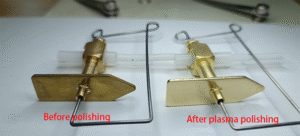
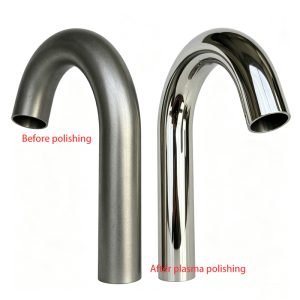
Produces smooth, shiny surfaces ideal for decorative and functional use.
4.4 Eco-Friendly
No harmful grinding dust, wastewater, or chemical pollution.
4.5 Suitable for Polishing Brass & Copper
Works well with copper alloys, making it flexible for multiple product lines.
5. How Plasma Brass Metal Polishing Works
Plasma polishing uses low-temperature ionized gas to react with the metal surface, removing microscopic layers evenly.
5.1 Deburring Mechanism
Micro-burrs are removed without affecting structural dimensions.
5.2 Surface Smoothing
Removes scratches & roughness to achieve mirror finish.
5.3 Compatible Materials
-
Brass
-
Copper
-
Stainless steel
-
Titanium
-
Aluminum
6. Comparison: Plasma Polishing vs Other Brass Polishing Methods
| Method | Surface Quality | Burr Removal | Environmental Impact | Dimensional Change | Best Use |
|---|---|---|---|---|---|
| Mechanical Buffering | Medium | Medium | Medium | High | Simple parts |
| Vibratory Tumbling | Low | Low | Medium | Medium | Large batches |
| Electropolishing | Medium | Medium | Low | Medium | Fine finishing |
| Plasma Polishing | High | Excellent | High | Low | Precision applications |
Plasma polishing delivers the best results in both consistency and burr removal.
7. How to Choose the Right Brass Buffer Machine
Key factors include:
7.1 Part Size & Shape
Different machines suit different geometries.
7.2 Required Finish Level
Mirror vs matte finishing.
7.3 Material Type
Brass and copper alloys respond differently.
7.4 Budget & Production Scale
Batch or precision continuous process.
When tight tolerances and high shine are required, plasma brass metal polishing machines are recommended.
8. Brass Polishing Process Flow
8.1 Surface Pre-Cleaning
Remove oil, grease, dust.
8.2 Deburring & Plasma Polishing
Plasma removes burrs & oxidation.
8.3 Final Mirror Polishing
Surface is refined to high gloss.
8.4 Inspection
Dimensional, visual, functionality checks.
9. Why Manufacturers Prefer Plasma Brass Polishing
9.1 Better Yield
Reduced rework; fewer rejects.
9.2 Reduced Waste
Minimal consumables.
9.3 Faster Production
Efficient polishing cycle.
9.4 Consistent Quality
Uniform results, no operator dependency.
These advantages make plasma technology a reliable method for professional brass polishing.

10. Case Studies / Use Scenarios
-
Connector manufacturer improved surface conductivity and eliminated burrs, ensuring reliable electrical contact.
-
Decorative hardware factory reduced manual polishing time by 60%, producing uniform mirror finish.
-
Precision valve supplier achieved clean sealing surfaces, improving assembly and leakage performance.
✅ Conclusion
A brass polishing machine is essential for improving the surface quality of brass parts. While traditional mechanical or tumbling systems are still used, plasma brass metal polishing machines are rapidly becoming the industry standard thanks to:
-
Superior burr removal
-
Consistent mirror finishing
-
Environmentally friendly operation
-
Non-destructive processing
For industries requiring precision, aesthetics, and reliability, plasma polishing is the best solution for professional brass polishing and polishing brass and copper components.
FAQ
1) What is the best method for polishing brass?
Plasma polishing offers the highest precision and consistency for industrial applications.
2) What is a brass polishing machine used for?
It removes burrs, oxidation, and improves shine for brass and copper parts.
3) Can plasma polishing remove burrs from brass?
Yes, it removes micro-burrs without damaging part dimensions.
4) Does a brass buffer machine damage parts?
Traditional buffering can, but plasma polishing is non-destructive.
5) Is plasma polishing environmentally friendly?
Yes, it produces minimal waste and no toxic chemicals.
6) Can the same machine polish brass and copper?
Yes, plasma machines are suitable for polishing brass and copper.
7) What is the difference between polishing and buffing?
Buffing uses mechanical abrasion; polishing achieves deeper refinement and smoother finish.


 English
 Français
 Deutsch (Schweiz)
 Italiano
 Русский
 한국어