
I. Introduction – Why Surface Quality Matters
In modern precision manufacturing, surface quality is a critical factor affecting product performance, safety, and durability. Nearly every industrial sector—from aerospace and automotive to medical devices and consumer electronics—relies on parts with clean edges, smooth surfaces, and accurate dimensions. Any unwanted burrs, sharp edges, or micro-scratches can cause assembly issues, decrease product stability, or even lead to premature failure.
Traditional finishing methods such as manual grinding, abrasive tumbling, and chemical polishing often struggle to deliver consistent quality. These approaches can cause deformation, leave residue, fail to reach internal features, or increase labor and environmental costs.
To address these challenges, manufacturers are increasingly adopting deburring and polishing machines that utilize plasma technology. This advanced deburring polishing machine removes burrs and smooths surfaces through high-energy plasma reaction—providing precise, repeatable, and non-contact finishing with minimal material loss. As industries move toward miniaturization and higher performance, plasma finishing continues to gain momentum as the ideal processing solution.
II. What Is a Deburring and Polishing Machine?
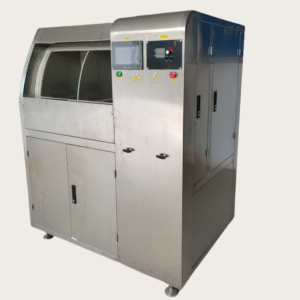
A deburring and polishing machine is specialized equipment designed to remove sharp edges, burrs, and micro-imperfections from metal or alloy parts while simultaneously improving surface finish. Unlike mechanical systems that rely on physical abrasion, the plasma-based deburring polishing machine uses ionized gas to selectively remove surface irregularities at the microscopic level.
This machine offers:
-
Precise material removal
-
Clean edge rounding
-
Enhanced smoothness & brightness
-
Minimal structural damage
It is especially effective for components with tight tolerances, fine geometries, and complex internal structures that are difficult to treat with mechanical or chemical methods.
III. How Plasma Deburring & Polishing Technology Works
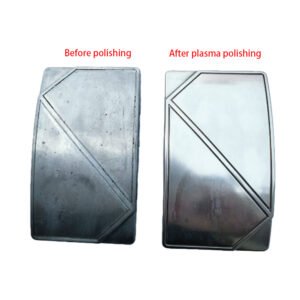
Plasma polishing uses high-energy ionized gas—plasma—to react with the metal surface. The plasma is composed of electrons, ions, and active radicals that interact with the workpiece, gently removing micro-layers of material.
Process Overview
-
Component placed into reaction chamber
-
Plasma generated under controlled temperature & pressure
-
Energetic ions strike the surface
-
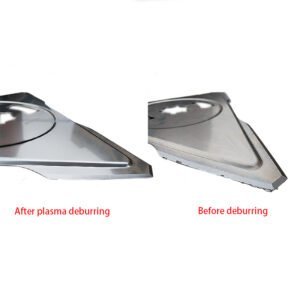
Micro-burrs and high-points are selectively removed
-
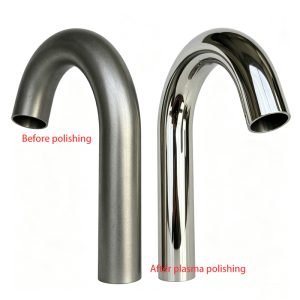
Surface is polished and edges are rounded
Because this is a non-contact process, the substrate is not physically stressed. It can access internal channels, micro holes, and complex contours—making it ideal for high-precision components.
IV. Advantages of Plasma Deburring and Polishing Machines
1. High Precision & Repeatability
The plasma process is highly stable and controlled, ensuring consistent finishing quality across batches.
2. Non-Contact Material Removal
No mechanical pressure is applied, preventing deformation or tool marks.
3. Ideal for Micro-Deburring
Removes micro-burrs that traditional grinding or tumbling cannot reach.
4. Enhanced Surface Quality
Significant reduction in surface roughness, improving performance and appearance.
5. Excellent for Complex Geometries
Can polish holes, channels, and fine features without leaving residue.
6. Reduced Tool Wear & Cost
No grinding wheels or abrasives mean lower maintenance and consumable costs.
7. Eco-Friendly Option
Less chemical waste and safer working conditions.
V. Applications Across Industries
Plasma-based deburring and polishing machines are widely used in:
● Precision Metal Components
High-tolerance parts in automation, optical systems, precision instruments.
● Medical & Dental Devices
Surgical tools, implants, micro-instruments requiring ultra-smooth surfaces.
● Automotive & Aerospace
High-performance metals that require optimal reliability.
● Consumer Electronics
Connectors, sensors, precision housings.
● Hardware & Micro-Machined Parts
High-volume parts requiring reliable finishing.
This versatility makes plasma finishing suitable for both small-scale precision items and large-batch industrial production.
VI. Deburring Polishing Machine vs. Traditional Solutions
| Method | Contact? | Precision | Complex Geometries | Environmental Impact | Notes |
|---|---|---|---|---|---|
| Manual Grinding | Yes | Low | Poor | Low | Inconsistent, labor-intensive |
| Mechanical Tumbling | Yes | Medium | Poor | Medium | May damage parts |
| Chemical Polishing | No | Medium | Medium | High | Chemical disposal required |
| Electro-Polishing | No | Medium | Medium | Medium | Limited for micro features |
| Plasma Deburring & Polishing | No | Very High | Excellent | Low | No deformation, clean finish |
Plasma finishing offers greater precision, better consistency, and excellent surface uniformity with lower environmental impact.
VII. Key Features to Look for in a Deburring and Polishing Machine
A high-quality deburring polishing machine should include:
-
Plasma-based processing system
-
Automated control & stable parameters
-
Consistent output surface quality
-
Material & geometry versatility
-
Customizable processing recipes
-
Safety protection systems
-
Easy maintenance & low consumables
These features ensure efficient finishing and long-term reliability.
VIII. Why Plasma Finishing Is the Future of Micro Deburring
Modern components—with smaller sizes, thinner walls, and complex geometries—demand a finishing method that is precise, safe, and consistent. Plasma technology meets these needs because it:
-
Works without mechanical force
-
Offers unmatched control
-
Minimizes environmental pollution
-
Reduces process costs over time
With growing demand for miniaturized and high-performance parts, plasma deburring and polishing machines are becoming the new industrial standard.
IX. How to Choose the Right Deburring and Polishing Machine
Key factors include:
-
Type of material (stainless steel, copper, titanium, etc.)
-
Structural complexity
-
Required surface roughness (Ra)
-
Part dimensions
-
Production volume
-
Budget & service availability
Choose a supplier with:
-
Professional consultation
-
Strong application experience
-
Custom process development
-
Reliable after-sales support
X. Case Example – Real Manufacturing Improvement
A precision component supplier for consumer electronics faced challenges removing burrs from small stainless-steel connector parts. Mechanical deburring left tool marks, while electro-polishing was inconsistent.
After adopting a plasma deburring and polishing machine:
-
Micro-burrs were completely removed
-
Surface finish improved from Ra 0.4 to 0.1 µm
-
Yield rate increased > 98%
-
Labor cost dropped by 60%
-
Production became fully automated
This demonstrates how plasma finishing dramatically enhances quality and cost-efficiency.
XI. Conclusion
As industries push for better performance, smaller dimensions, and tighter tolerances, traditional polishing methods can no longer keep up. Plasma-based deburring polishing machines deliver a breakthrough solution by combining precision, consistency, and eco-friendly manufacturing.
With exceptional capability for micro-deburring, edge smoothing, and surface enhancement, plasma finishing is redefining modern production—creating cleaner, smoother, and more reliable components across multiple sectors.
Jinyuan has been dedicated to metal polishing and deburring solutions for many years, specializing in handling complex surface finishing challenges. If you are looking to enhance your product surface quality and production efficiency, feel free to contact us for professional support.
FAQ
1) What materials can be processed?
Stainless steel, titanium, copper, nickel alloys, and more.
2) Is plasma deburring safe for fragile parts?
Yes. It is a non-contact process that avoids deformation.
3) Does plasma polishing damage the base material?
No, it removes only surface micro-layers.
4) How smooth can the surface become?
Surface roughness can reach Ra ≤ 0.1 µm depending on materials.
5) Is chemical waste produced?
Very little, making it eco-friendly compared to chemical polishing.
6) Is it suitable for high-volume production?
Absolutely. The automated system ensures consistent results.
7) Which industries benefit the most?
Medical devices, aerospace, automotive, electronics, precision hardware, and more.


 English
 Français
 Deutsch (Schweiz)
 Italiano
 Русский
 한국어